

The challenge is a widespread and serious one: how do we address Violence Against Women and Girls (VAWG)? Everyone should be able to feel safe and thrive in their local community. Yet, VAWG cuts through everyday life, impacting activities at home, workplaces, schools, online platforms or in public spaces.
It spans a broad range of harm—physical, sexual, psychological and financial abuse, and its long lasting effects ripple out through individuals, families, and communities involved.
When Maidstone Borough Council surveyed residents on Violence Against Women and Girls, the results were stark: of 664 people who responded, almost a third said they had experienced physical or sexual abuse. It's a sobering local signal of a much wider national problem.
In a December 2024 motion, Maidstone Borough Council committed to taking stronger, evidence-based action on VAWG, including:
- Developing a comprehensive VAWG Strategy
- Promoting a Women’s Night-Time Safety Charter
- Embedding women’s safety in town planning
- Working towards White Ribbon accreditation
This is a deeply rooted societal issue that touches every part of community life. Lasting change needs shared understanding, community involvement, and legislation and services shaped by the experiences and values of local people. Recognising this, MBC’s Housing and Community Cohesion Committee emphasised the importance of ‘lived experience’ within this work. That’s why MBC took a deliberative approach. This is where we came in.
It was daunting at first being very quickly it felt relaxed, motivating and encouraging to see the council wants to listen and hear from the community.
Read our report here.
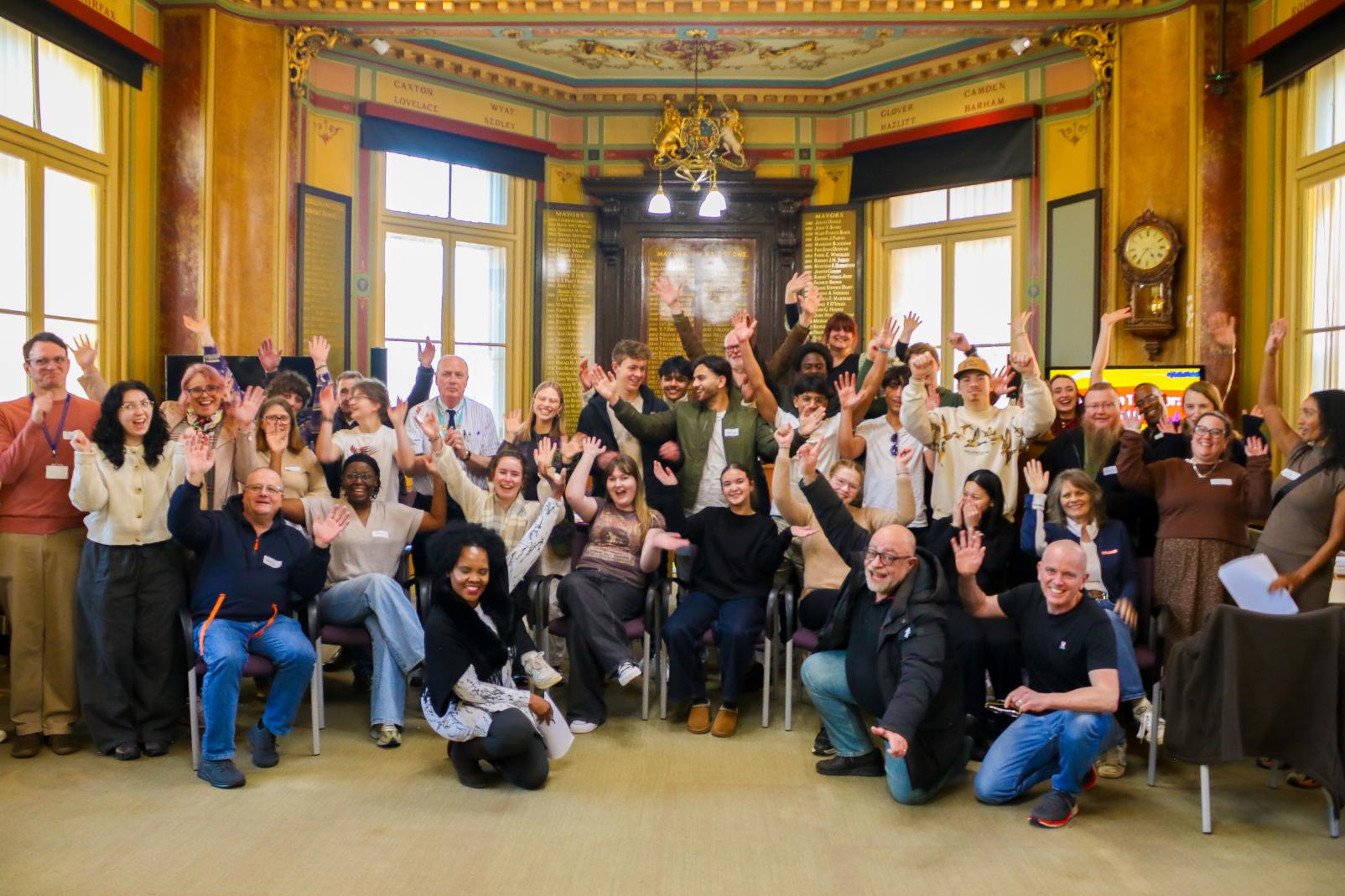
Maidstone Borough Council partnered with Involve to launch Maidstone Together: A Community Discussion. Over four structured sessions, 37 members of the Maidstone community explored issues such as harmful behaviours, online harassment, and building safer public spaces.
Alongside the residents, we brought in the people who can take action on VAWG and the strategy, including elected members, council officers, charities, service providers, anchor institutions and community leaders, through an Advisory Group. Working with the council's VAWG Action Group, (a sub-group of the Safer Maidstone Partnership) they helped shape the project, checked the evidence was balanced, and reviewed the final recommendations, making sure the process worked for Maidstone and that people felt ownership over what came out of it.
In order for this to work, we needed to make sure we could reach Maidstone residents including its young people. We required people who were broadly demographically reflective of Maidstone’s community. People were recruited through a combination of community outreach, paid social media ads, local newsletters, college drop-in sessions and market research in underrepresented areas. Local Voluntary Community Sector (VCS) groups submitted referrals and applicants completed a short survey with their demographic information to inform selection.
Of the 109 people who applied, 37 people were randomly selected based on recruitment targets for the following criteria: age, gender, ethnicity, social economic background and urban and rural areas. These criteria were set against national statistics (Office of National Statistics, Census and Index of Multiple Deprivation) and recent council engagement. By oversampling demographics traditionally underrepresented in the Council’s consultation activities and minoritised groups to ensure that if a person dropped out the group, the group’s diversity is maintained.
Involve designed this process as an enclave deliberation — a structured deliberative approach where some of the discussions take place within groups that share a particular identity, experience or perspective. For this project, the four groups were organised by age and gender: women, young women, men, and young men. All groups were trans and non-binary inclusive.
For a topic as sensitive and complex as VAWG, enclave deliberation is an effective
way to support honest, substantive discussion. It allows for communities that may otherwise struggle to have their voices heard in broader settings to explore issues deeply within a ‘safe’ setting, laying the foundation for constructive ‘brave’ deliberation in whole group settings. In June 2025, a public dialogue in Belfast applied this method by organising 45 residents by age and gender to safely explore preventing violence in outdoor spaces, generating seven community-led recommendations for safer, more inclusive environments.
In Maidstone, participants came together to share experiences, hear from experts, and develop practical actions that will feed directly into a live VAWG Action Plan for the borough. Together, the 37 participants developed eight final recommendations in response to the question:
What can we all do as a community to stop Violence Against Women and Girls before it starts and ensure their ongoing safety?
The wording and language of the recommendations are from participants directly.
It is important for the recommendations to remain in participants’ own words to reflect their ideas and intentions without interference or bias.
The eight calls to action were (ordered by votes of support):
* These recommendations were identified by participants as areas for further public engagement
| 1)🎓 Lifelong learning* (25 votes) | Learning about VAWG should be lifelong, engaging and accessible - through formal, informal and non-formal education, the workplace, and in community spaces. Learning must be relevant to people’s real experiences. There should be equal access to lifelong learning. |
| 2) 🗳️ Government action* (23 votes) | MBC should advocate and lobby central government for a VAWG Lead Coordinator in every parish and district, and eventually county council to make sure VAWG is high on every political agenda. |
| 3) 🧑⚖️ Women's representation in positions of decision making (21 votes) | There is proportional representation of women and gender minoritised people in positions of decision making. |
| 4) 🔄Support to increase disclosures and provide long term support for survivors (19 votes) | Create a single, trusted ‘STAR’ (Safe, Trained, Action, Response) support system that enables safe disclosures, provides immediate support, delivers coordinated long-term care, and empowers survivors of VAWG to access justice and healing. |
| 5) 💰 Poverty reduction and cycles of abuse (16 votes) | We must break the cycle of poverty by investing in families to stop abuse continuing. |
| 6) 🌳 Public spaces (16 votes) | Make our public spaces places where everyone feels safe and can enjoy being outside. Ask communities what would improve spaces for them, run public awareness raising campaigns in public spaces to discourage poor behaviour and signpost to support. Improve visible security (e.g. clean streets lighting, CCTV, patrols). |
| 7) 💬 Difficult / uncomfortable conversations about VAWG* (14 votes) | Through education and facilitated discussions we can actively encourage conversations in our community about important, and difficult topics like VAWG. If we don’t have these conversations, public awareness decreases and gives VAWG the opportunity to fester and grow into a big social issue. |
| 8) 🛋️Shared social spaces for young men and women (14 votes) | Bring back free youth clubs, run as a charity, with local government funding. |
What was the impact?
I felt helpless at the start and inspired after today.
In May 2026 the Safer Maidstone Partnership's (SMP) VAWG Action Group used the eight recommendations to directly develop the VAWG Action Plan.
In July 2026, Maidstone Borough Council’s Cabinet - the group of senior councillors responsible for major council decisions - approved the Action Plan securing approval to:
- Approve the VAWG action plan and commit to building a safer, more inclusive community.
- Allocate £250,000 to deliver the recommendations while actively seeking match-funding from partners and central government streams.
- Appoint a new Women’s Safety and Violence Prevention lead to drive this work forward and hold partners accountable to the plan
- Endorsed a cross-party commitment for all local political parties and councillors to work collaboratively to improve the representation, safety and participation of women in local democracy
Cabinet recognised the significant commitment made by the 37 participants and their foundational role in the creation of the VAWG Action Plan.
They also recognised the value of deliberation on a challenge as complex as VAWG doesn’t end with a report; it also means building capacities and expertise to continue to embed the public in policy development. The Council identified key learnings from the process:
- Large-scale deliberations require substantial preparation time - a minimum of six months - and original timescales were over-ambitious.
- Officer investment in supporting recruitment is invaluable and significantly increases engagement.
- The original tender specified a Citizens' Assembly methodology, which limited supplier engagement. Subsequent tenders have taken a more open approach, inviting bidders to propose their own methodology in response to stated outcomes, producing stronger and more competitive processes.
- Involving statutory partners and delivery organisations early in process design strengthens the translation of recommendations into local action. This has been embedded into subsequent projects.
- Broader stakeholder involvement in working with participants increases knowledge-sharing, buy-in, and the robustness of recommendations.