

In this edition of The Involve Insight
- A powerful model for the core facilitation skill of intervening
- Hints and tips for running small group discussions (Read them here)
- Our upcoming training programmes (Learn more and book here)
- A quick guide to the International Association of Facilitators’ core competency framework (See it in full here)
- Help shape our training offer (share your thoughts here)
At Involve, we have the privilege of supporting organisations, institutions and authorities who are looking to develop their skills and understanding of participatory, dialogue and deliberative public engagement processes, facilitation skills, engagement methods, and more.
In the 'Involve Insight', we bring you some of the insights from the full breadth of this work. This month, though, we’re shining a spotlight on facilitation skills.
Now that I’ve settled into my role at Involve, I’m seeing more and more requests for facilitation skills training. And I love it — because after 28+ years in the field, I’ve seen first-hand how good, professional facilitation can transform public engagement in decision making.
In this facilitation focussed edition of The Involve Insight, you’ll find:
- A powerful model for the core facilitation skill of intervening (one of my facilitation practice ‘ah-ha’ moments).
- Hints and tips for running small group or table-top discussions (where a lot of public engagement magic happens).
- A quick guide to the International Association of Facilitators’ (www.iaf-world.org) core competency framework.
Let’s dive in once again…
The skill of intervening
Great facilitation draws on many skills: crafting great questions, attentively listening, summarising, paraphrasing, capturing outputs — the list goes on. But there’s one skill at the heart of them all, underpinning everything: intervening. That’s the art of noticing what’s happening and stepping in, respectfully, to steer things in the right direction — whether to build on a breakthrough or to gently defuse a problem.
I first came across Edgar Schein’s Intervention Cycle model many years back, early on in my facilitation practice, and it has underpinned everything I do ever since.
Being able to observe and understand what is happening (or not!) in a group, what is being said and why, filtering different perspectives, managing group and individual dynamics and having strategies to transform dysfunctional (and functional) behaviour, managing the group in an effective way.
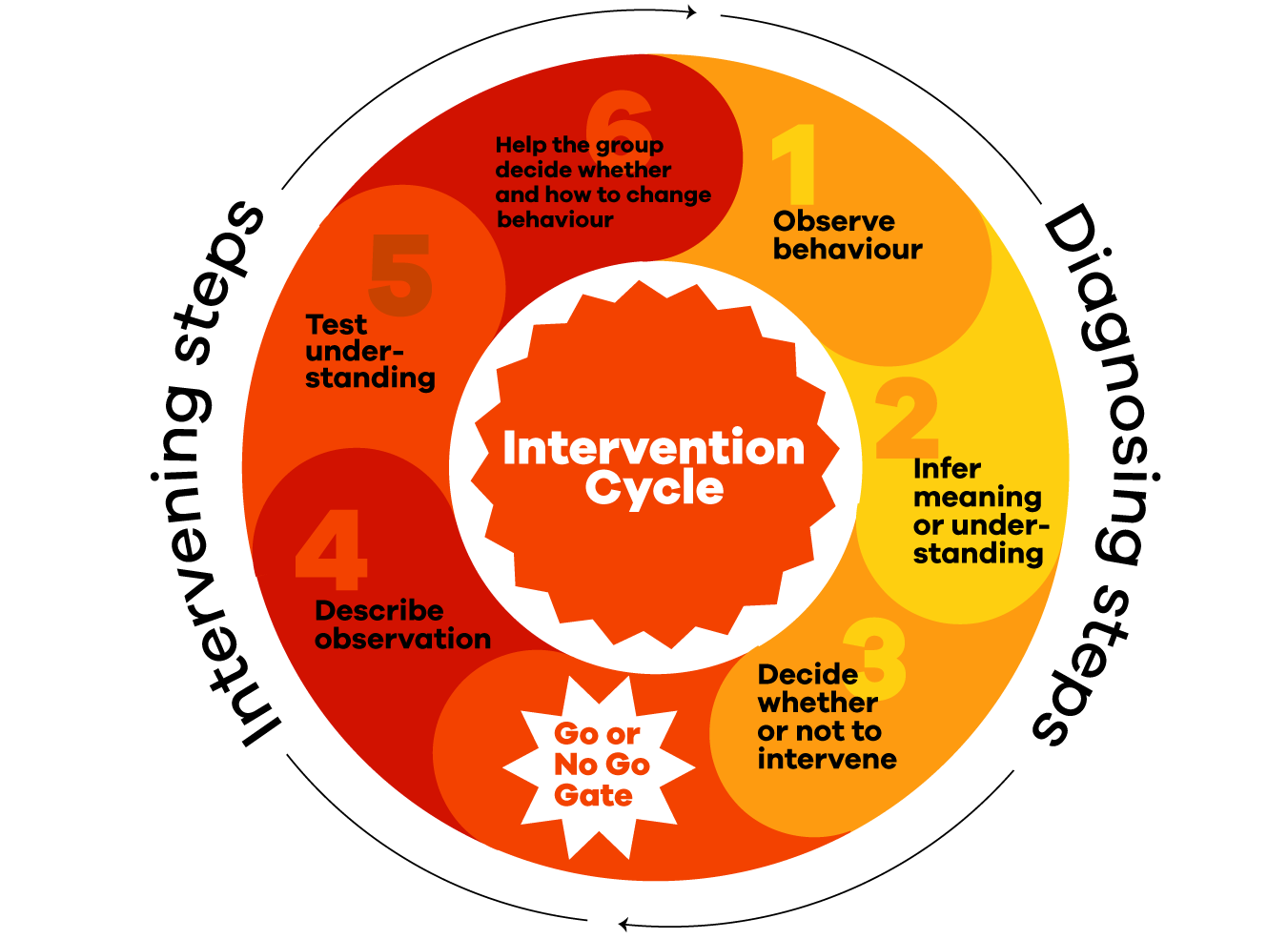
Schein outlines two stages of intervention, the diagnosing stage and the intervening stage, each with three steps.
Diagnosing steps
Step 1 - Observe behaviour
Here we are observing, watching the group, actively and attentively listening to what’s being said/not said, looking for functional and dysfunctional behaviour.
Step 2 - Infer meaning or understanding
Here we are trying to make sense why/why not, looking for rationale, trying to work out why something might be happening, or why something is being said.
Step 3 - Decide whether to intervene
Here, we are making many micro-decisions whether or not we need to intervene, step in, to manage something (positive or negative) OR NOT, as in, if I just leave it a little longer then either it resolves itself, the group resolve it etc.
Go/No Go gate
The decision is made to intervene!
Intervening Steps
Step 4 - Describe observations
In this step, I am describing to the group what I have seen or heard, and I am owning my intervention, so I am NOT saying “I just want to stop us there because ‘Jane’ you look and sound really angry about that”, I am using I statements, so “I just want to stop us there because I am sensing we are not all in agreement, or I am sensing there is some tension in the room, does anyone else feel like that, and if so why?”
Step 5 - Test understanding
In sharing MY observations, I am enabling the group to explain why they are being as they are, why they are saying what they are, and I am able to confirm, or not, my reading and understanding of what is going on.
Step 6 - Help group decide whether and how to change behaviour
In this final step, we work together as a group to identify what might need to be done differently, or what additional information we might need etc. in order to move on.
Of course, it doesn’t stop there, it’s not a linear process, this Intervention Cycle IS my background conversation, running in my head, ALL the time, what am I seeing/hearing, why is that, do I need to do something about it or not (intervene?), step in, explaining what I am seeing/hearing, trying to understand why from the group, and helping the group decide what to do or say next. And you may go round the diagnosis steps loop several times before actually deciding you need to intervene.
Hints and tips for effective small group/table top facilitation
More often or not, in public engagement processes, there will be elements of the process that need small group, or table top facilitation. We've put together some new hints and tips of good practice that can help.
Over on our Knowledge Base you'll find practical advice on setting up your small group sessions for success — from how to introduce yourself and clarify your facilitation role, to ensuring every voice is heard and stepping in smoothly to manage group dynamics. Whether you’re guiding the discussion, handling disagreements, or summarising what’s been said, these tips will help your sessions flow and ensure everyone’s contributions count.
Visit the Knowledge Base for more
Help us shape Involve’s Training – we want to hear from you!
At Involve, we’re always looking to improve the way we support facilitators and public engagement professionals. That’s why we’re asking for your input! Whether it’s the best time for training to take place, specific facilitation challenges you might be struggling with, or any burning questions you want answered, we want to know!
Your insights will help us create a training offer that meets your needs. Take a moment to share your thoughts by filling out our quick Google Form here. It only takes a few minutes, and your feedback will help us design training that works for you.
International Association of Facilitators (IAF) core competency framework for facilitators
The IAF is a professional body and organisation, and as facilitators, we’re always looking for ways to sharpen our skills and bring more value to the groups we work with.
Developed collaboratively by facilitators around the world (including myself), this framework lays out the essential skills, knowledge, and behaviours that help us succeed in any setting — whether we’re working with small community groups or large organisations.
It covers everything from building strong client partnerships and designing inclusive group processes, to managing conflict and guiding groups toward meaningful outcomes.
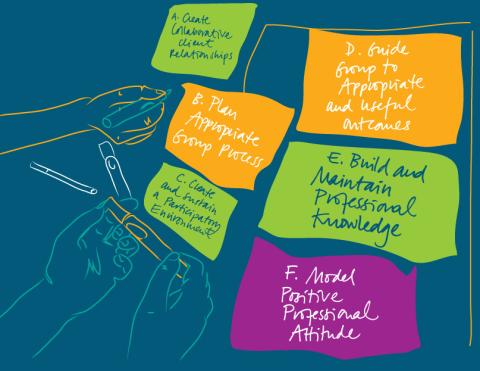
Here’s a quick overview of the core areas in the IAF framework:
A - Create collaborative client relationships
Partnering closely with clients to understand needs, deliver tailored processes and manage multi-session events effectively.
B - Plan Appropriate Group Process
Designing sessions that foster open engagement for diverse participants and respect their unique cultures and learning styles, and prepare/arrange appropriate space and logistics to support the purpose of the meeting.
C - Create and Sustain a Participatory Environment
Apply a mix of participatory processes, demonstrate effective verbal communication skills and develop rapport with participants. Honour and recognise diversity, ensuring inclusivity and manage any group conflict respectfully.
D - Guide Group to Appropriate and Useful Outcomes
Facilitate the group with clear methods and processes, build group self-awareness about its task, vary the pace of activities according to needs of the group and guide the group to desired outcomes.
E - Build and Maintain Professional Knowledge
Build and maintain a base of knowledge, tools, and methods, be knowledgeable in the theory and practice of group process facilitation and maintain a professional standing, engage in ongoing study / learning related to our field.
F - Model Positive Professional Attitude as a Process Facilitator
Practice self-assessment, self-awareness and self-correction, act with integrity, demonstrate a belief in the group and its possibilities and approach situations with authenticity and a positive attitude.
The full IAF facilitator competency framework can be found here.
Read the full competency framework here
Involve facilitation skills training
At Involve, we see how organisations, institutions and governments at all levels are increasingly recognising the transformative power of good, professional facilitation.
That’s why we offer our Facilitating Public Engagement Training for organisations and institutions — a programme designed to give you and your team the tools, methods, approaches and confidence needed for meaningful and inclusive facilitation.
Our facilitation skills training aims to build capacity, competence, and confidence in designing, planning, preparing for, and facilitating public and deliberative meetings, workshops and events.
Learning Objectives include:
- To outline facilitation principles and explore core roles and skills of a facilitator, including intervening
- To understand the role of dialogue and deliberation; divergent and convergent purposes
- To learn core facilitation techniques
- To identify challenging situations and behaviours and how to manage them
- To understand how to design and plan sessions
- To practise key facilitation skills
We deliver this training as 0.5 day awareness training, and more in-depth training in both 1 or 2 day programmes. On the 2 day programme we build in facilitation practice sessions for all participants.
Take a look at what past participants had to say:
Really helpful session on learning facilitation techniques. Great way to also learn from others working in different fields and using a different approach to facilitation.
A fantastic session exploring tricky situations and how to become a more engaging facilitator. Insightful, practical, and highly recommended!
Exceptional in both theory and practice of facilitation with real-world application. Really helped me reflect on my facilitation practice and ways I can improve it. Highly recommended.
Good facilitation is a core skill and this training is the way to develop that. This should be mandatory and accredited so we can raise the bar working through the multitude of challenges that are facing us in today’s world. Moving forward with compassion, skill, and connection
If you would like to more about any of the Involve training, or have a training related question, or something you would like to share about our training please email Gary at [email protected]
Upcoming training sessions
Take a look at what we have coming up below...
Public Engagement Training
Join us for our Public Engagement Training to build your awareness of public engagement in decision making: what it is, why it is important and how to develop your public engagement brief!
📆 Thursday, November 6 · 9:30am - 1pm
👉 Sign up here
Facilitating Public Engagement Training
Our Facilitating Public Engagement Training is for leaders, public engagement officers, and facilitators working in public engagement looking to learn more about core facilitation principles, skills, tools and techniques in the public engagement space.
📆 Thursday, November 13 · 9:30am - 1pm
👉 Sign up here
What else is happening?
- IAF Asia Facilitation Conference - 3rd-4th September 2025
- Facilitation Shindig Edinburgh - 12th September 2025
- Facilitation Shindig London- 17th September 2025
- Act Build Change - Introduction to transformative community organising - 18th September 2025
- Act Build Change - Emotional resilience in community organising (collective care) - 14th October 2025
- IAF Europe & Middle East (EME) Facilitation Conference - 7th-9th November 2025
Thanks!
That's it for the Insight for this edition. If you would like to more about any of the Involve training, please reach out to me at [email protected]
Thanks!