


This blog was written by Steph Draper and Emily Tulloh as part of our work supporting Innovate UK's Net Zero Living Programme. You can find out more about or work as part of the programme here.
Local authorities have an important role to play in tackling climate change, with one third of emissions dependent on sectors that they can directly shape or influence. Through our work on UKRI’s Net Zero Living programme, we’re thrilled to support 28 places across the UK with their citizen engagement work.
One of the most common requests we come across when starting a conversation with climate colleagues in local authorities is ‘how can we persuade people to change their behaviour to reduce emissions?’
This is a reasonable ask. The UK’s Seventh Carbon Budget outlines that over a third of emissions reduction by 2040 relies on household choices: how we move around, how we heat and power our buildings, and in things we buy, eat and use. So it’s no surprise that 69% of local authorities say they could benefit from support in developing skills and expertise relating to educating the public or changing public behaviour.
Why a focus on ‘behaviour change’ is limiting
When holding discussions about behaviour change in our processes, we often experience people pushing back if they feel like the responsibility is being passed to them. Instead, communities want to see leadership and consistent action from all levels of government to enable net zero to be accessible and affordable.
We often experience people pushing back if they feel like the responsibility is being passed to them. Instead, communities want to see leadership and consistent action from all levels of government.
Research shows that resistance to climate policy can occur when communities feel excluded from decision making and perceive it to be unfair. This is compounded when what people are being asked to do is not easy, affordable or logical, or conflicts with deeper values they hold.
We’ve seen this play out. Think of the low traffic neighbourhoods that were accelerated during the pandemic. A BBC Panorama episode spotlighted the public backlash, with car gates being set on fire, run over and destroyed. In some areas councillors received death threats over the changes.
Other examples are less obvious, such as campaigns to encourage people to walk or cycle to school or work which simply have little sustained impact, or lead to changes in route choice rather than new uptake.
When we solely focus on behavioural economics, we risk missing the social, economic and cultural structures which we inhabit. Even when local authorities use behavioural tools such as ISM (Individual, Social and Material) or COM-B (Capability, Opportunity, Motivation, Behaviour), they can miss the opportunity to engage with citizens on the wider ‘meaning’ of policy in people’s lives or develop a deeper understanding of the hopes, needs, fears and aspirations that drive our everyday decision making.
Why involve the public in climate decision making
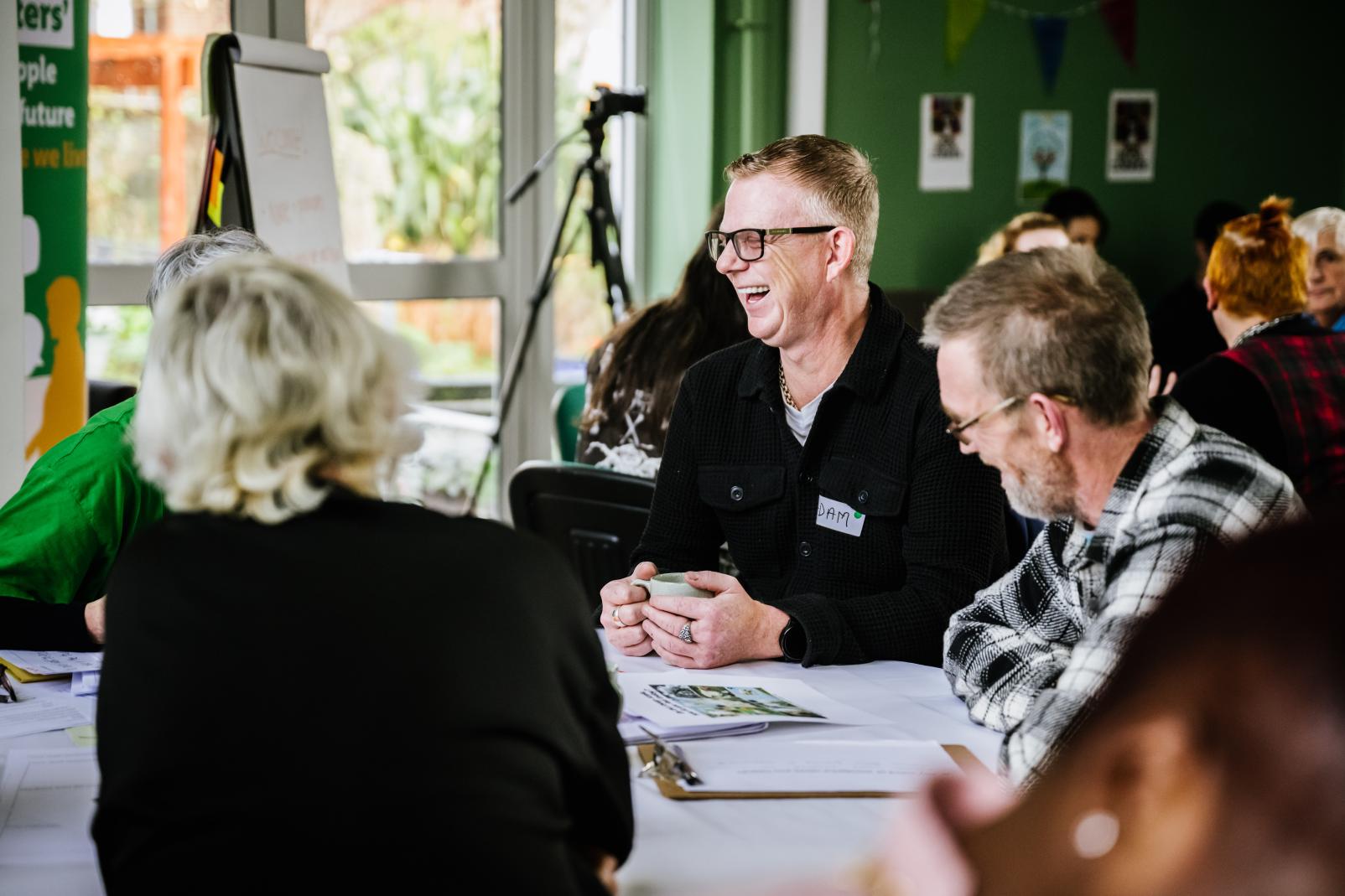
In our current landscape, trust in politics and institutions is at an all time low. That’s why, more than ever, it is essential for changes that require public support to be made alongside communities.
Rather than the usual approach of ‘decide, announce, defend’, involving people in decision making or scheme design is about investing the energy and resources up front.
By engaging with people first, local authorities can explore scenarios, understand potential challenges and design workable solutions with people before investing significant resources, rolling back or modifying schemes, or doubling-down on public relations.
Research shows that deliberative public engagement can lead to more effective and acceptable climate policies and avoid policy failure. Instead of limiting community members to their role as consumers, involving people in their capacity as citizens can bring in diverse perspectives, test ideas and ultimately increase trust between citizens and decision makers.


Better climate decision making in practice
Our experience consistently shows that bringing together diverse perspectives can result in new ideas and perspectives and - ultimately - better decisions.
The Southampton Citizens’ Climate Assembly called for safety, including street lighting to be a priority, to enable women and girls to feel confident to travel around the city on foot or by bike.
The West Midlands Greener Together Panel proposed conditions that would help them come along with changes - including thriving high streets reducing the need to travel further afield.
And the Blackpool Community Conversation highlighted the importance of bus drivers to have accessibility training, to ensure that public transport worked for everyone.
These are proposals that may not be found in a typical climate action plan. But these are just some of the enabling conditions that communities call for to take action on climate change in a way that works for everyone.
Involving people in decision making doesn’t always need to mean a full-scale Climate Assembly. In our work on Net Zero Living, we’ve been using citizen visioning as a way to start. It is a condensed process that starts with community assets and what makes a place unique, before deliberating on how action on climate change might support the things that people value. There are other approaches too: Distributed dialogues, like the Welsh Climate Conversations, offer a way to facilitate conversations in communities in parallel; Innovations like the Stanford Platform for Online Deliberation unlock opportunities for deliberation at scale; and Nesta’s Strategy Room uses storytelling and scenarios to rapidly test the acceptability of climate policies.
And what’s more, the experience of being involved in decision making can be transformative for people, resulting in new interests and ‘greener’ choices. Research on Climate Assembly UK showed that two years on, participants still thought and acted differently. When power is shared with people to make decisions, it can result in a level of intrinsic motivation that no carrot or stick can compare to.
When power is shared with people to make decisions, it can result in a level of intrinsic motivation that no carrot or stick can compare to.
Our invitation to climate teams
At Involve, we think it critically important that the conversation about individuals’ roles in climate change extends beyond nudges and behaviour change.
We would encourage climate colleagues in local authorities to ask: ‘How can we involve the public in our climate decision making? How can we meaningfully share power so that changes work for our whole community?’
That way, people will have a stake in the future we’re trying to create. By going beyond behaviour change, local authorities can work alongside their communities to design the infrastructure, schemes and supporting measures to make sense in people’s lives as they experience the wider benefits of acting on climate change.