


This blog was written by Steph Draper and Emily Tulloh as part of our work supporting Innovate UK's Net Zero Living Programme. You can find out more about or work as part of the programme here.
So often, engagement around climate change starts with a top down agenda. Climate strategies are developed with emissions targets, projects and plans - and then we ask people to get on board. But what if we took a different approach?
Over the past year, we’ve been working with 28 local authorities through Innovate UK’s Net Zero Living programme to explore a new perspective. One that doesn’t lead with climate, but with people’s experiences and aspirations for their local area. Then we ask how we can deliver that vision through action on climate change.
Our ambition is for these visions to translate into actionable recommendations and projects that genuinely influence local authority decision making. So has this happened? And what are we learning?
The challenge of starting with climate
This request to engage the public with the climate agenda is a common starting point. Yet research shows there is no neutral way to frame climate change. This report by the Knowledge Network on Climate Assemblies illustrates how the framing of climate change directly influences how participants understand and respond to policy options. This is echoed by Climate Outreach and their fantastic work on Britain Talks Climate, which highlights how different messages resonate with different audiences. At the same time we are dealing with a constant push back in the media that critiques net zero approaches.
What’s more, the impacts of climate change are unequally distributed. Research from Joseph Rowntree Foundation illustrates how low income communities are the least responsible for climate change, whilst are most at risk from the devastating impacts. So it’s no wonder that one of the major challenges we hear from local authorities is: ‘How can we reach beyond people we usually hear from? How can we involve people for whom climate change might not be a top priority?’
When we frame our participatory processes around climate change, we’re asking people to fit in with institutional priorities and plans, and risk entering into a polarised agenda. So could there be another way?
Instead of trying to bring people into climate strategies, what if we started with people and place? What if we created space to imagine the future of our communities, and then built climate in?
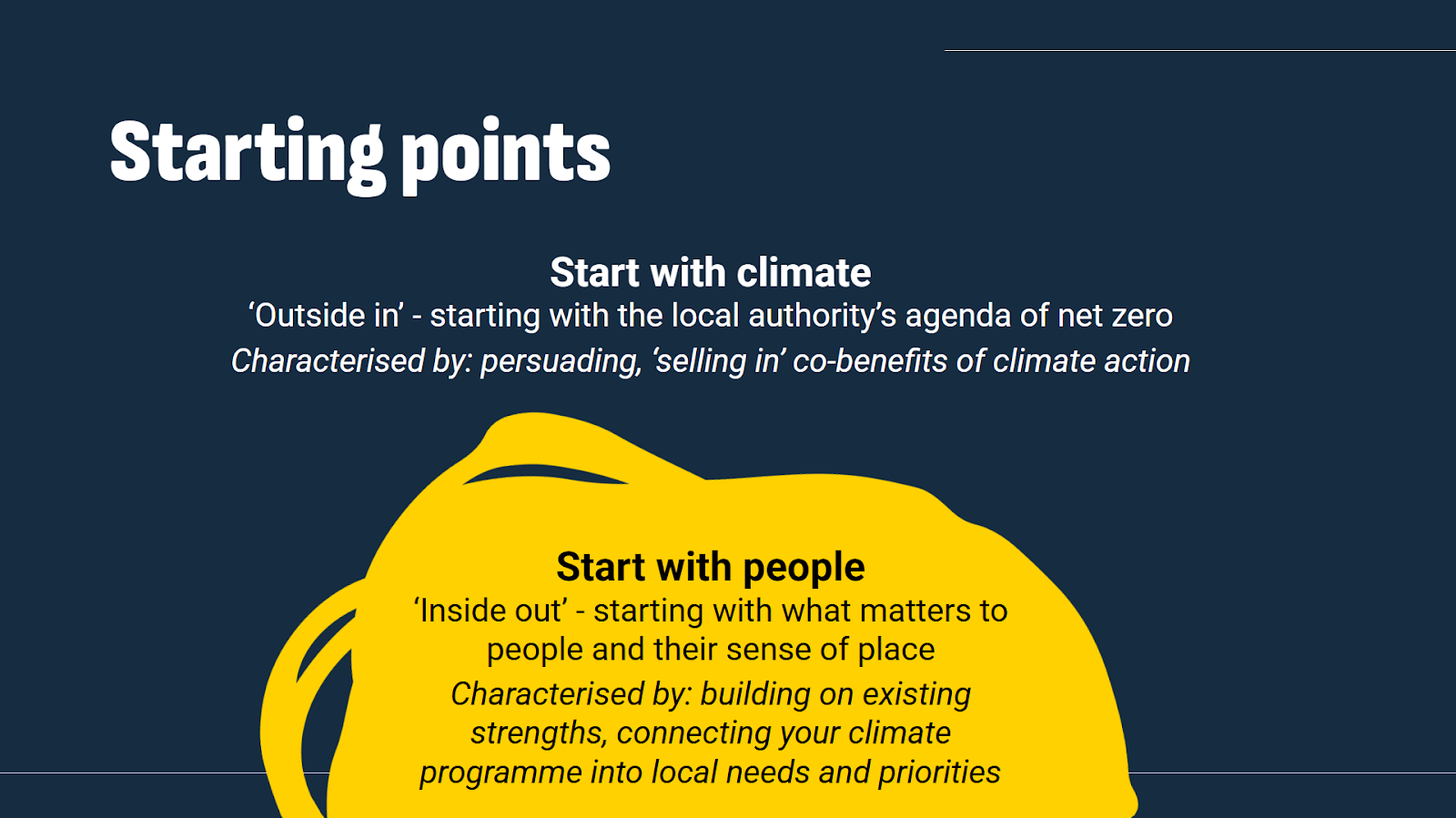
Reframing the conversation
This idea isn’t new. It resonates with the work of Rob Hopkins, who invites us to imagine the future by asking ‘What If?’ This power of collective imagination is illustrated beautifully through Ruth Ben-Tovim’s Town Anywhere.
In Ireland, we see how participatory models like the People's Transition frame climate action as an enabler of local development. In eight communities (and counting), each project begins with a listening phase to understand local needs and priorities before scoping climate solutions that address these.
And in Australia, Regen Melbourne has applied this thinking to a city scale. Working with over 500 people and 50 organisations from across the city, the co-created vision for a regenerative city acts as a north star to guide a set of highly ambitious projects.
What unites these approaches is starting with what matters to people about their place, rather than a ‘top down’ agenda of delivering a climate strategy.
Visioning in practice
We started this work with a hypothesis that there was an opportunity to bring together asset-based visioning with the magic of deliberation. We were clear that any vision needed to be backed up with a set of practical recommendations. So we set out to produce a set of future proofed priority actions that engage with trade offs.
One year into the programme, here’s some examples of the recommendations we're seeing…
In Gateshead, we saw citizens develop a vision for the town’s energy future, with priority actions including a ‘Green Room’ where the community can learn and share about low-carbon technologies for their homes being taken forward.
In neighbourhoods across Derry City and Strabane, residents from across the council including economically underserved, and rural areas had conversations in their communities to help shape and prioritise recommendations. These ranged from ending the use of herbicides on road verges, using citizen science to monitor water quality and changing how spatial planning operates to improve transparency in how decisions are made.
Residents in Wakefield and district prioritised actions that build community connection, including an electric bus linking rural areas to town, and an annual festival to share and learn from net zero initiatives.
In North Woolwich, more than half of the actions were focused on the role local corporations and large infrastructure could play, going above and beyond their role to cut emissions to include actively supporting and funding the community.
In Warrington, young people’s vision for the future included regeneration around the River Mersey, with a range of actions to deliver this including training and jobs for young people creating flood defences.
And in Blaenau Gwent, citizens called for increased publicity, capacity and funding for the ‘fflecsi bus’, a local on demand bus service. This included asking the council to work more closely with local employers to better align bus services with shift patterns. The recommendation reflected both current needs, like access to health services, town centres and communal spaces, and a collective memory of past transport systems, when collieries and steelworks provided transport for workers."
While the above examples are just one of many recommendations that communities came up with, what we’re learning is that starting with assets can result in visions that are unique to each place and community. And that the visioning process itself can be a great entry point to deliberation on specific recommendations - not so focused on producing a vision but in enabling participants to share what they value, what they want for their communities and to think forward.
Communities setting the agenda
Carrying out people or community-centred engagement activities from a place or assets point of view can be challenging for councils used to statutory consultations or traditional engagement activities. In this setting, communities set the agenda. The results can be unexpected.
In Blackpool, alongside recommendations for energy efficient homes and more green spaces, the community wanted a bigger role in decision making, calling for more resident involvement and collaboration across departments. In a process focusing on climate adaptation, this was an unexpected outcome.
So whilst calling for ‘more involvement of residents in decision making’ might not be part of your typical climate adaptation strategy, it does share a clear, bigger picture vision of what a thriving Blackpool looks like for the community in future. It reflects the community appetite for agency and action, providing the council with a real opportunity to harness this and enable people to get involved.
Blackpool Council have publicly responded to all nine priority recommendations, outlining their commitment to take them forward. This includes plans for a new Service Advisory Panel to involve residents in decision making.
There is much we can learn from Blackpool’s approach, where climate colleagues act as connectors, working across the organisation to land citizen priorities in other departments’ strategies and plans.
Looking ahead
We are finding that starting with people and place is a much more meaningful way into the climate agenda. We are learning as we go, but we think that by starting with people and place we can generate climate solutions that truly respond to community needs and priorities and create more scope for transformative societal action.
Instead of asking ‘How do we engage people with climate change?’ we can ask: ‘What does our community value about where they live? What makes our place unique? And how can we build on these assets to co-design a vision for a thriving place, in the context of changing climate?’
We are hopeful that this is a scalable approach at a number of levels. As a baseline, the premise of starting where people are is critical in climate engagement and immediately applicable to so many changes.
In August 2025, we will be sharing a toolkit that maps out this approach to citizen visioning, for others to use and adapt. We hope that it will be a useful contribution to help connect the dots between climate action and what matters to communities.