
Blaenau Gwent is an area in the Welsh valleys with a strong industrial heritage and a history of activism and resilience. It has deep valleys running North to South, which are home to close communities, with hills between them that can make it hard to get around. The villages here were built on coal and steel, but since the coal pit closures in the 1980s, residents have faced high rates of unemployment and relatively low public investment in services such as transport.
Most people in the area drive, but for the 23% without a car getting to work and school can be a challenge. The houses are mainly Victorian and the roads were not designed for modern traffic, meaning the streets are congested and the pavements narrow and hard to navigate. There are some options for walking and cycling, but people need more support to use them. So far, discussions around travel haven’t focused much on climate change or the push for net zero.
The local council has different teams working on travel, from walking and cycling (active travel) to those working on school transport. Many of those working at the council live in the area and care deeply about improving services for residents, but they don’t have shared objectives for local travel. Funding is a challenge, and lots of the powers to make changes rest with the regional authority or Transport for Wales. In 2021, local partners held the Blaenau Gwent Climate Assembly. The ideas from this were ambitious and broad, and while some have shaped changes to local transport, some of them have been hard to implement.
What did we do?
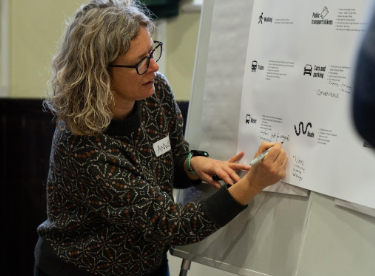
The Future of Travel Citizens’ Forum was set up by the council and Involve to find practical solutions that could be put into action over the next five years. They chose the Citizen Visioning method to make sure that solutions built on the existing strengths of communities and services in Blaenau Gwent. A group of local people, reflective of Blaenau Gwent’s population, came together over three sessions to develop a vision, weigh up routes forward and agree on a set of recommendations.
Having a clear set of ambitions, developed by citizens, can help coordinate action taken by the council to get policy right the first time. By stepping back and ensuring projects connect into a wider vision for a place, specific challenges can be unblocked.
The question that the forum set out to answer was:
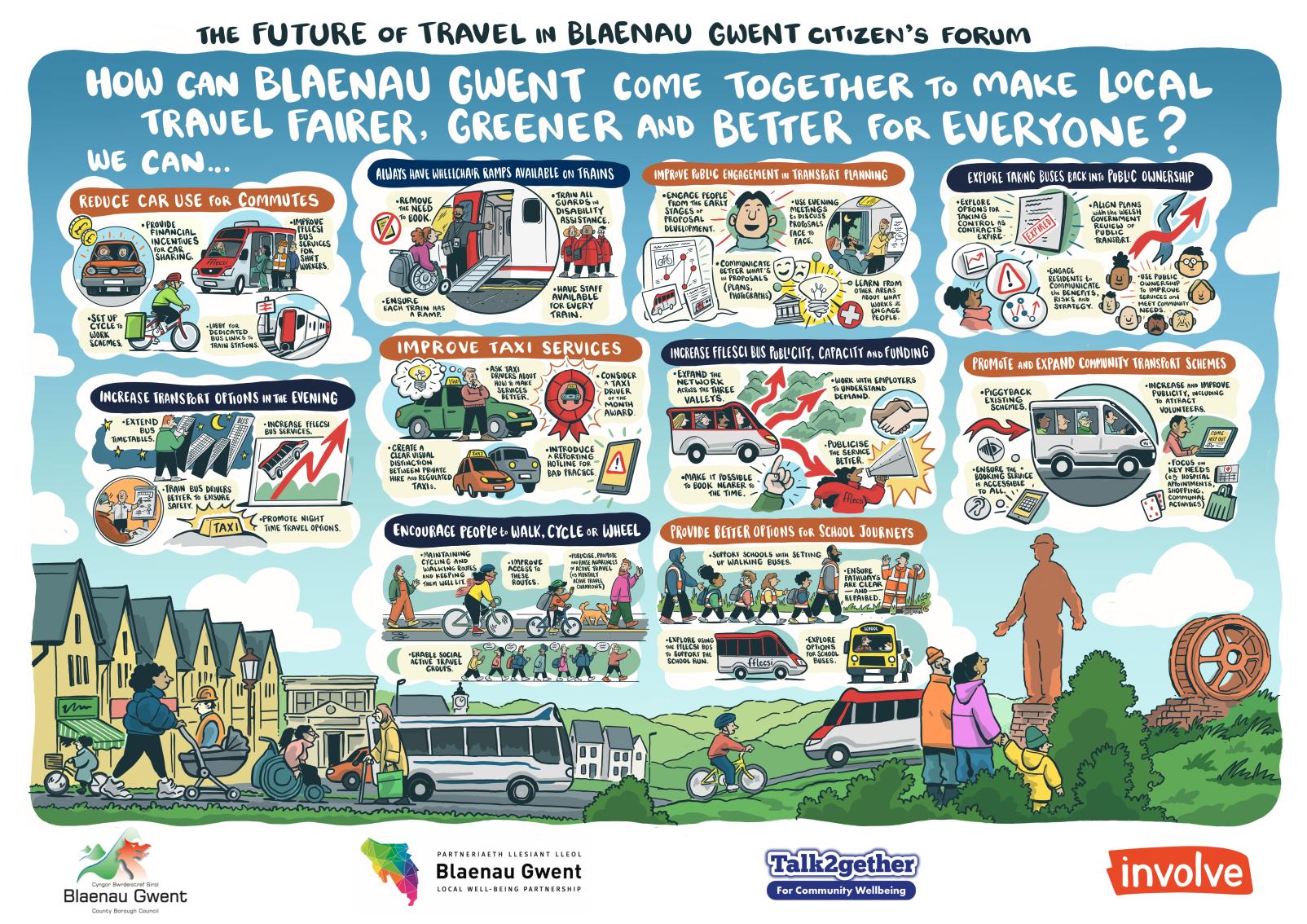
How can Blaenau Gwent come together to make local travel fairer, greener and better for everyone?
The forum discussed what they liked and disliked about current travel options in the area, and used this as a starting point to develop their vision. This built a shared idea of an ideal future as a foundation for their recommendations.
The forum heard from a range of speakers on a number of topics, including climate and net zero, different travel solutions in the local area and elsewhere, and about the challenges and opportunities the council and partners are facing. They had a chance to ask speakers questions at tables, and spend time with them at lunchtime. They also considered their own travel choices in small groups - what journeys they make, how they travel, and why - and reflected on what it takes to change habits and attitudes.
The council especially wanted the forum to spend some time exploring what “fair” means to Blaenau Gwent residents when it comes to travel. The forum deliberated on questions such as “is it fair to ask everyone to make one small change in their travel habits?”. They combined their thoughts into a set of “fairness guidelines” for the council to use when it is making any decision about travel in the area.
Finally, the forum used all the ideas and information they had heard to agree a set of ten recommendations for the council. Each recommendation had a headline, a description of why it was important, and a list of actions.
What resulted?
The forum produced a report on the future of travel in Blaenau Gwent, which includes a vision, a set of fairness guidelines, and ten recommendations.
Some of the recommendations build on local heritage. The forum took place in the Llanhilleth Miners’ Institute, a community centre which originated as a meeting place and support structure for miners and their families. Several of the forum members were new to the area, while others had family stories of local history. They shared these with each other, remembering how there used to be communal transport to take workers to the collieries and steelworks, timed with the start and ends of shifts. These memories led to their recommendation for the ‘fflecsi’ bus service (a local on demand bus) to work collaboratively with employers in the industrial parks to understand working hours.
Forum members reflected on how it felt to take part in more meaningful engagement: some said this was the first time they’d been to a public meeting of any sort, while others already played leading roles in their local communities. These reflections come through strongly in their recommendation on community engagement, where they wrote “people need a voice on what’s important to them”, and that “people’s expertise and knowledge is as important as the experts’”.
The forum took into account existing challenges and work that had already been done and made recommendations based on what was achievable. For example, rather than asking the council to develop new community transport schemes, the forum decided they should “extend and promote existing community transport”. This was because the group had identified that not many local people knew about the options already on offer, and that there was a lot of existing good work being done in this area that the council could easily “piggyback off”.
Some of the recommendations were more ambitious. For example, when the group suggested that the local bus service should be taken into public ownership, the council fed back that while this was possible, it would take a long time and was not completely in their power. Despite this knowledge, the forum decided it felt strongly enough to ask the council to lobby for public ownership of buses, even if this change would not happen in the short term. They suggested the council start with something manageable, and “explore the option of council control of the bus service as private contracts expire”.
What was the impact?
Impacts of the forum’s work were seen while it was still underway. The Deputy First Minister for Wales, Huw Irranca-Davies, visited Blaenau Gwent in February 2025 to meet forum members and hear about their work. He intends to use the Citizens’ Forum as an example to learn from as part of the Welsh Government’s work on innovating democracy.
Throughout the process, forum members’ confidence grew in terms of how they felt about the future of travel and the changes they wanted to make to how they travel in their local area.
Involve supported local decision makers to observe the forum in action. In particular, local councillors came to open the forum and to observe the final session respectively. Some of these councillors have expressed their support for the forum and will be important champions for the recommendations in the future. Involve is providing them with briefings to support them with this.
To make sure that as many other members of the council were on board, forum members presented their recommendations to local councillors at a special two-hour long briefing. Involve worked with members to train and prepare them to speak about the forum and their recommendations for the highest possible impact. The councillors asked lots of questions of the forum members, and at the end reflected that their own campaigning priorities aligned with the forum’s recommendations, making the forum’s report very useful for them.
The advisory group, which met throughout the process, was made up of council officers, councillors and local partners who would be responsible for delivering the recommendations.
As a group it was collegiate and productive, and everyone who took part was curious about each other’s work and the work of the forum. The group is already an example of council teams and wider partners learning about what other teams do and working together more on cross-cutting travel solutions.
As part of this commitment to work together, the council has also asked Involve to run a workshop with officers, councillors and partners on the implementation and response to the recommendations, which will inform the council’s response to the forum’s report.