

Co-design is a participatory approach to developing solutions to challenges.
Description
According to the Sunlight Foundation, co-design refers to a participatory approach to designing solutions, in which community members are treated as equal collaborators in the design process.
It involves bringing together three types of expertise: crucially, those who have 'lived or living' experience of the challenge being solved, or who will be impacted directly by the solution, people with professional experience of the issue; and specialists or academic experts, or datasets.
It is about:
- Exploring problems and solutions and learning together.
- Respecting and treating each other as equal partners.
- Engaging in a process, rather than a single or one-off event.
It is important to define co-design clearly and to avoid overusing it or using it as a stand-in for other types or levels of public engagement. Its overuse and misuse can lead to misunderstanding, misplaced expectations, and participation fatigue among communities and service users.
Co-design is one of many approaches within the broader field of public participation and engagement. It is closely related to co-production: where co-design involves people in designing a solution, co-production extends that partnership into delivery, with people sharing responsibility for running or providing a service. Together, co-design and co-production are often described as co-creation.
Because co-design is a specific approach, it is important to define it clearly and not use it as a stand-in for other types or levels of engagement. Overuse and misuse of the term can lead to misunderstanding, misplaced expectations, and participation fatigue among communities and service users.
Co-design is not needed, possible, or the right approach in every situation. It is ok not to do co-design, and it is important not to say co-design is happening if it isn't.
Where co-design sits
The International Association for Public Participation (IAP2) has developed a five-part spectrum of participation: Inform, Consult, Involve, Collaborate and Empower.
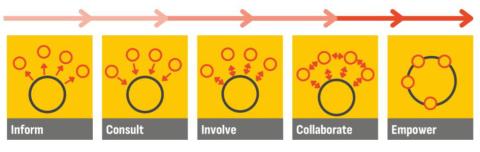
Co-design begins at the level of 'Collaborate'. That means: where a process doesn't involve all three types of expertise, or where there isn't meaningful collaboration (shared responsibilities in developing ideas, assessing options and making recommendations) or empowerment (final decision making), it should not be labelled as co-design.
This act of working collaboratively should be from the very start. For example, all co-designers are involved in writing the co-design brief, which sets out the overview, scope, purpose, outputs, existing strengths, timeline, budget and resources. The group refers back to it as the process progresses. The group also pauses to reflect on how the process is going, and again at the end.
If you are not able to do this from the beginning, it is not co-design.
Used for
- Developing a solution, such as a new service, product, campaign or coalition, to a problem that disproportionately impacts a particular group of people
- Defining a problem and developing a solution together, where a problem has been identified but no engagement has taken place
- Designing a solution with experts by experience, where earlier engagement didn't involve people with lived or living experience
Participants
Participants are the 'relevant people': those with lived or living experience, those with ‘practice experience’ (professional experience), and those with ‘research evidence’ (academics). ‘Sponsors’ are those who initiate and resource the process, set out what is expected, ask co-designers what support they need to participate meaningfully, and support them to make decisions throughout the process.
Recruiting participants well means:
- Involving people with lived or living experience from the earliest opportunity, and drawing on local networks to reach them.
- Identifying minoritised voices early and including them directly, rather than relying on organisations that support them to represent their voice.
- Never relying on one voice to represent diverse lived or living experience.
- Considering sortition, civic lottery or other random selection techniques to identify co-designers from the communities who may otherwise not take part.



Costs
Co-design needs to be adequately resourced, with people supported to get involved. Depending on the process, this can include:
- Compensating co-designers for their time
- Paying or reimbursing out-of-pocket expenses, such as transport or caring costs
- Interpreters, and information in different languages and formats
- Equipment so people can take part in the same way as others, for example laptops for online meetings, or well designed printed documents
- External facilitators, where needed
- Trauma-informed practice to ensure the safety of co-designers
Approximate time expense
Co-design is not a single meeting or workshop. It needs time to prepare, to build relationships and trust, to develop the co-design brief together, and to reflect along the way. Some flexibility is needed, but commitment to timelines can help build trust in the process, so the group should work together to find the right balance.
Strengths
- Brings together three types of expertise: lived or living experience, practice experience and research evidence
- It places lived and living experience at the centre of the work, with experts by experience collaborating from the earliest stages through to the final decisions, including in shaping how the challenge is defined and how success will be measured
- Exploring an issue from many perspectives can open up new, creative solutions
- Can build trust and confidence among participants
- Can address problems that disproportionately affect particular groups
Weaknesses
- Not the right approach in every situation, and may not be possible without first addressing underlying issues so that co-designers and sponsors can turn up ready to collaborate
- Needs adequate resources and support for participants, including compensation for their time
- Requires people with power and influence to commit to the process at an early stage, with clear institutional pathways to impact. Otherwise, the process can lead to fatigue, mistrust and harm
- Likely to add to participation fatigue where a recent consultation led to no change, or where the issue is a low priority for the people most affected
- Can be undermined by tokenism, by unexplained jargon and acronyms, or by using co-design to finalise or rubber-stamp what you want to
Find out more
- Belfast Community Planning Partnership, Co-Design Framework & Toolkit (developed by Involve and Community Places)
- Blomkamp, E. (2024). Shades of Co-Design. Medium.
- Jordan-Detamore, G. (2019). Introducing a guide to co-design for local open data programs. Sunlight Foundation.
- McKercher, K.A. (2020). Beyond Sticky Notes: Doing co-design for real: mindsets, methods, and movements. Sydney, Australia: Beyond Sticky Notes.
- IAP2 International Federation (2018). IAP2 Spectrum of Public Participation.
- Involve's Knowledge Base