
Citizens’ assemblies bring together people from all walks of life – selected randomly, but to be demographically representative – to consider a public issue in depth over multiple days and meetings.
Assembly members hear evidence, question witnesses and deliberate with one another, before reaching recommendations on what they think should be done. Citizens’ assemblies put the trade-offs faced by decision-makers in front of members of the public and ask them to arrive at workable recommendations.
There has been growing interest in citizens' assemblies – and other models of deliberative democracy – in the UK over the past few years. This resource gives some guidance on how to establish a citizens' assembly. It is based on our own experience of running a large number of citizens' assemblies in the UK, on a variety of topics from climate change to hate crime, and social care to the future of town centres.
Frequently Asked Questions
Below are some answers to the frequently asked questions we often hear about citizens' assemblies.
These include:
- What is a citizens' assembly?
- Why are citizens' assemblies sometimes referred to as mini-publics?
- What are the advantages and disadvantages of citizens' assemblies?
- How long does it take to organise a citizens' assembly?
- What does it cost to hold a citizens' assembly?
What is a citizens' assembly?
A citizens’ assembly is a group of the public who are brought together to consider a public issue in depth over multiple days and meetings.
Assembly members hear evidence, question witnesses and deliberate with one another, before reaching recommendations on what they think should be done. Citizens’ assemblies put the trade-offs faced by decision-makers in front of members of the public and ask them to arrive at workable recommendations.
The people who take part are randomly selected so they reflect the wider population – in terms of demographics (e.g. age, gender, ethnicity, social class) and sometimes relevant attitudes (e.g. preferences for a small or large state).
Citizens' assemblies adopt a three-step process involving:
- learning – assembly members hear evidence from witnesses;
- deliberation – assembly members carefully consider what they have heard, weighing up the pros and cons of different courses of action; and
- decision making – assembly members develop recommendations and/or make decisions on what they think should be done.
See our draft citizens’ assembly standards for more details on the key features of citizens’ assemblies.
Why are citizens' assemblies sometimes referred to as "mini-publics"?
Citizens’ assemblies are one form of a mini-public. Citizens’ juries, public dialogues, consensus conferences and deliberative polls are other examples of deliberative methodologies using mini-publics.
The term mini-public simply means that the participants in the assembly are recruited to be reflective of the wider population in terms of demographics (e.g. age, gender, ethnicity, social class).
What are the advantages and disadvantages of citizens' assemblies?
Like any public participation model or method, citizens’ assemblies have both pros and cons that make them suitable for some circumstances and not others.
| Advantages | Disadvantages |
|---|---|
The process can be high profile and provide a good way of drawing attention to an issue It can bring out diverse perspectives on complex and contested problems Decision-makers are brought face-to-face with citizens or those with lived experience of an issue Learning phase and deliberation with peers can help participants to understand, change and develop their opinions; Offers policymakers an insight on public opinion on a contested issue based on the public having access to thorough and unbiased information and time for deliberation. | Gaining a broadly representative group of people can be challenging and expensive The process for developing and planning an assembly is intensive and demanding on human and time resources Running a citizens’ assembly is a highly complex process requiring significant expertise There is a danger of being seen as a publicity exercise if not followed by real outcomes |
How long does it take to organise a citizens' assembly?
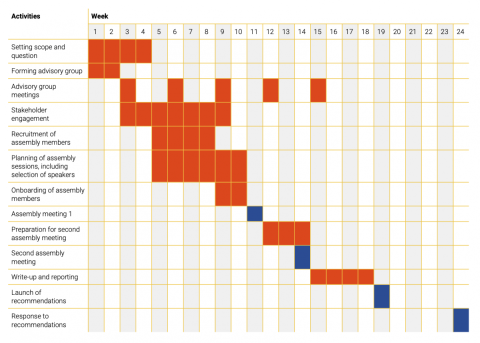
Organising a citizens' assembly is a significant commitment and requires time to get right. The exact amount of time will depend on the size and complexity of the process, including how many times it meets. Key considerations are the time required for:
- Getting agreement on the scope and question;
- Establishment of an advisory group;
- Recruitment of assembly members;
- Identifying and securing experts/witnesses;
- Number of assembly meetings;
- Reporting requirements.
The diagram below gives an indicative timeline for a local citizens' assembly that meets over two weekends.
What does it cost to hold a citizens' assembly?
There are lots of factors to build into a citizens' assembly direct costs including:
- Recruiting assembly Members and paying their expenses and gifts
- Suitable venue and accommodation including refreshments (for assembly members and the wider team)
- Fees for the organisation convening and facilitating the assembly – in the preparation, design, delivery and reporting
- Expenses (and sometimes fees) for expert leads and speakers
Key variables in costs will be determined by
- The number of assembly members you want (and therefore a knock-on cost in terms of recruitment, payments, expenses and venue size)
- How long your process will take - i.e. how many weekends (and therefore knock on costs in terms of payments, expenses and venue costs)
The table below provides an indicative budget for a local citizens' assembly, consisting of approximately 50 participants for 32 hours of learning, deliberation and decision-making. Costs are given as ranges, as they are dependent on the specifics of the circumstance.
| Items | Approximate Costs | Notes |
|---|---|---|
| Participant costs | £20,000 – £30,000 | Development of the invitation, mail out to randomly selected households and stratification of respondents A gift (~£75 per day) for participants to recognise and reward their involvement Reasonable travel expenses |
| Witness / expert costs | £500 – £1,500 | Reasonable expenses for those invited to speak Reasonable expenses for advisory group members |
| Venue, catering and accessibility | £7,500 – £15,000 | Suitable venue Tea and coffee breaks and lunch Provision for BSL, hearing loops, braille, interpretation and caring costs |
| Preparation and design | £15,000 – £25,000 | Designing the assembly process Liaison with the advisory group Stakeholder engagement Background research Developing materials and liaison with participants |
| Assembly meetings | £20,000 – £30,000 | Lead facilitation Small-group facilitation Support staff Travel, accommodation & subsistence |
| Reporting and participant liaison | £3,000 – £6,000 | Writing up of report of recommendations Ongoing liaison with participants |
Standards for citizens' assemblies
Not all assemblies of citizens are citizens’ assemblies – and neither do they need to be. There is a vast toolbox of public participation methodologies that can be used to involve people in decision-making in a variety of ways.
While it’s important that standards do not curb innovation, it’s critical that methods are not watered down beyond recognition. A citizens’ assembly is a specific democratic tool to be used in specific circumstances. Their power comes from their robust process, which gives a representative group of the public time and support to engage with a topic in depth. But this process makes them time and resource-intensive compared to many other methods of engagement, so citizens’ assemblies should be reserved for the really knotty issues that require challenging trade-offs to be made.
Where these circumstances exist, a citizens’ assembly can make a substantial contribution to helping to resolve an issue — but it must be properly resourced and well run to enable it to succeed.
It's with this in mind that we developed some draft standards for the citizens’ assemblies that we design and run. These are based on our own practice, understanding of the international practice and a range of standards that have already been developed across the globe (including by us). They are intended as a starting point for discussion with other practitioners, experts and commissioners to refine them over the coming weeks and months. We hope that they might form the basis for some collectively agreed standards among practitioners and commissioners in the UK.
Draft standards for citizens' assemblies
The standards below are organised into “essential” and “desirable” features of ten criteria:
- Clear purpose
- Sufficient time
- Representative
- Inclusive
- Independent
- Open
- Generative learning
- Structured deliberation
- Collective decision-making
- Evaluated
We consider the essential features to be the fundamental things that make a citizens’ assembly a citizens’ assembly. The absence of any one of these features would require detailed justification and would only be warranted in exceptional circumstances. The desirable criteria are the additional features that we consider to be current good practice.
| Criteria | Essential | Desirable |
|---|---|---|
| 1. Clear purpose | There is a clear question / set of questions for the assembly to address, which has / have a range of different possible solutions The scope for making a difference to the policy or decision is explicitly declared at the start and things that are out of scope or cannot be changed are clearly outlined Decision-makers make a public commitment to consider and respond in detail to the recommendations | There are a clear set of trade-offs for the assembly to address There is support for the citizens’ assembly from across key political divides The assembly is commissioned by a public authority with responsibility for the issue in question |
| 2. Sufficient time | The time available is proportionate to the question / purpose There are multiple meetings with time between for reflection There is sufficient time for each of the three phases of the citizens’ assembly: learning, deliberation and decision-making The assembly lasts for at least 30 hours (4 days) in total | The assembly lasts for 45 hours (6 days) or more |
| 3. Representative | 40 or more assembly members are recruited 1 A pool of potential assembly members is created through random selection, using a recognised market research recruitment methodology Assembly members are selected from this pool using random stratified sampling based on demographic criteria to ensure that they are broadly representative of the wider population | 100 or more assembly members are recruited The pool of potential assembly members is created through a full civic lottery / sortition process. Civic lotteries are used within a deliberative democracy process to include ordinary people who wouldn't typically put themselves forward. Protecting their identities follows established best practice for this model, for the same reasons juror identities are protected: to allow participants to deliberate freely, without lobbying or external pressure. Where relevant, assembly members are selected using attitudinal sampling (as well as demographic sampling) to ensure that they are broadly representative of the wider population |
| 4. Inclusive | Assembly members are reimbursed for all reasonable expenses A gift of at least £50 per day is given to assembly members The accessibility requirements of assembly members are met on request Carers of assembly members are welcomed and provided for There is a ratio of max 9 assembly members per group facilitator Presentations by witnesses are accessible, avoiding jargon and not assuming prior knowledge | A gift of at least £75 per day is given to assembly members Information / materials are provided in a range of different formats The care costs of any assembly members are reimbursed and/or caring facilities are provided onsite (e.g. a creche) The accessibility requirements of assembly members are anticipated and met There is a ratio of max 7 assembly members per group facilitator |
| 5. Independent | The assembly is impartially facilitated (both lead and group facilitation) Key decisions about the citizens’ assembly agenda and design are reviewed by an independent advisory group to ensure their balance and impartiality | The assembly is run at an arm’s length from the commissioning body |
| 6. Open | The recruitment methodology, advisory group membership, speaker lists, agendas and briefing materials are published in full The process plan / design is published The assembly’s conclusions are published in full Decision-makers publicly respond to the recommendations | All evidence sessions are live-streamed |
| 7. Generative learning | Assembly members hear balanced, accurate and comprehensive information and evidence Assembly members hear from diverse witnesses with a range of views Assembly members determine their own questions for witnesses and have sufficient time to question them Witnesses are briefed so that they clearly understand that their role is to stimulate and support discussions among the assembly members, not to lead or direct them The learning phase supports the subsequent deliberation and decision-making phases, enabling assembly members to arrive at informed and considered judgements | Assembly members select at least some of the evidence and/or witnesses they wish to hear |
| 8. Structured deliberation | Assembly members are supported through a facilitated process to consider and weigh-up different perspectives Assembly members are given time to discuss issues with as many of their fellow participants as possible The assembly process is well structured, with a clear progression through learning and deliberation, to decision-making The assembly process is designed and led by professional facilitators The assembly process allows time for plenary feedback and summing up, so that assembly members can hear views from across the assembly Facilitators are well briefed and provided with any necessary training ahead of the citizens’ assembly | Small group discussions are facilitated by professional facilitators, with experience of deliberative processes |
| 9. Collective decision-making | A defined decision and/or set of recommendations is reached as an integral part of the process Assembly members consider all key trade-offs and their decisions / recommendations are internally consistent Decisions and/or recommendations are agreed collectively by assembly members Reports of the assembly outline the rationale behind decisions / recommendations | Assembly members are given a variety of ways to express their views – both collectively, through the discussions, and individually through other methods, such as voting, post-it notes, postcards or flip charts Where relevant, a minority report with dissenting opinions is produced Assembly members are involved in writing the report of their recommendations Assembly members are involved in presenting their recommendations to decision-makers |
| 10. Evaluated | Assembly members are surveyed to collect their views on their experience and the quality of the process, including the impartiality of facilitation, the balance of evidence and the opportunities to participate | An external evaluation is completed of the process and its impact
|
- 1Other deliberative processes, such as citizens’ juries and citizens’ panels, involve fewer participants
1. Clear purpose
How do I decide whether to run a citizens' assembly?
As with other forms of public engagement, there are a number of different things you need to consider before deciding if you should run a citizens' assembly; specifically:
Has the decision already been taken?
Unless the decision is genuinely open and undecided you should not commission a citizens' assembly. You need to be very clear about the scope of the assembly and which elements of the policy questions have already been decided and which the public can meaningfully influence.
Are decision-makers prepared to act on its outcome?
The assembly must only consider questions which fall directly within the competency of the body commissioning it. While the assembly might identify additional recommendations for other bodies, the commissioning body must be able to act on the core of the recommendations. It must be willing to communicate the additional recommendations to the responsible body/ies.
In addition, the commissioning body must be willing to take the assembly’s recommendations into account as it makes its final decision.
Is a citizens’ assembly the most appropriate method?
A citizens’ assembly is a specific democratic tool to be used in specific circumstances. Their power comes from their robust process, which gives a representative group of the public time and support to engage with a topic in depth. But this process makes them time and resource-intensive compared to many other methods of engagement, so citizens’ assemblies should be reserved for the really knotty issues that require challenging trade-offs to be made. There is a vast toolbox of public participation methodologies that can be used to involve people in decision-making in a variety of ways.
Are sufficient resources available to ensure the assembly can run effectively?
These resources include the financing required to cover the costs of designing and running the assembly, supporting participants to attend, covering the event costs and ensuring that participants have the information, in easily understandable formats, they need to make an informed decision.
Resources also includes the time needed to recruit participants, design the engagement process and for the assembly to report into the policy decision process. See here for an insight from an organisation that has commissioned one.
What do I need to do to develop a citizens' assembly?
The way a deliberative process is planned and designed, and the techniques used, depends on the circumstances, such as:
- the purpose of the process, and its scope;
- the numbers of people to be involved;
- the resources required;
- the timescale of the process;
- the geographical spread (local, national, international);
- the point in the policy cycle at which the process takes place;
- how complex, contentious or technical the topic is; and
- what the mix of specialists and public participants needs to be.
Deliberative public engagement processes can take place on any scale – from ten participants (for example, citizens’ juries) to thousands of participants (such as citizens’ summits). A process may be a one-off event, or part of a series of activities running over several years. See here for more information.
2. Sufficient time
How much time does a citizens’ assembly need?
Citizens’ assemblies are best used to address complex and (often) contested issues. As such, they typically require at least four days worth of meetings for assembly members to go through this process of learning, deliberation and decision-making. Some assemblies have run for 6 months or longer meeting once a month or even once a fortnight.
3. Representative
How many members does a citizens’ assembly need?
The idea of a citizens’ assembly is to reflect, as closely as possible, the diversity of the wider population with the members of the assembly. As far as possible, people should be able to see “people like them” in the membership of the assembly. This typically means that citizens’ assemblies covering larger populations (e.g. national) require more members than those covering smaller populations (e.g. local).
Citizens’ assemblies typically have between 50 and 200 members.
The number of members is one of the distinguishing features of a citizens’ assembly, compared with other deliberative mini-publics, such as citizens’ juries (which have fewer) or deliberative polls (which have more).
Who takes part in a citizens' assembly?
Members of the general public take part in citizens' assemblies. They are recruited to be broadly reflective of the demographics of the place in question (town, city, local authority or nation). In practice this will mean that the final make-up of the assembly will reflect the gender, age, socio-economic status and ethnicity of the population in question. Often where this might lead to one member from a particular minority (say ethnicity, or in the case of a UK-wide assembly the devolved nations) that minority is over-recruited.
Some assemblies also try to reflect the wider population’s attitudes to the policy the assembly will be discussing. For example, the 2017 Assembly on Brexit was recruited so that the members had voted 48% remain and 52% leave in the EU referendum. Other assemblies have recruited on the basis of attitudes to government or to mirror value modes.
Assembly members will have no professional connection to the issue under discussion by the assembly, so they will not work in a government department working directly on the issue, or be a member of a campaign group actively advocating for a specific position on the issue, for example.
The composition of the assembly's members will be determined by the demographics of the geography which it is intended to reflect. For example, a citizens' assembly deliberating on a UK wide issue would recruit participants who, as a whole, reflected the UK’s demographics. This would include the basic demographics above, but would also be likely to include geographic spread across the English regions and the devolved nations.
Citizens’ assemblies called by a combined authority region, city or local authority are likely to mirror this type of make-up, but at the smaller geographic scale, ie by borough or ward.
If the number of participants in the assembly is relatively small, it may be necessary to over-recruit certain demographics to ensure that more than one person ‘represents’ a specific demographic criteria.
Sometimes participants are also recruited to ensure that the mini-public is reflective of wider attitudes such as the way participants voted in the 2016 EU referendum, or concern for the environment. The proportions of such attitudes in the wider population will already need to be known through data from elections or robust survey methodologies, for example.
It is important to be able to show that who you have recruited measures up against existing data on any demographic criteria chosen as the basis for recruitment (e.g. census data)
How are public participants selected to take part in an assembly?
As noted above, assembly members are recruited to be broadly reflective of the demographics of the geography in question (town, city, local authority or nation and potentially attitudes to the policy under discussion).
There are broadly three methods for recruiting participants:
- Sortition/ civic lottery - which uses random selection to identify potential assembly members initially, followed by selecting participants at random from that pool to match the sampling criteria. In practice what this means is that 5,000 - 10,000 letters (depending on the size of the assembly) are sent to random postcodes in the sampling area. Recipients are asked to register to join the assembly by providing some basic demographic information. This creates the pool from which the final sample is randomly selected from.
- In person - uses either telephone, or on street recruitment (or a mixture of both) to identify assembly members. Once the sampling criteria have been agreed, a recruitment company will approach people at random (either at their homes from the electoral register or in the street), complete a basic survey with them and if the person is willing to take part in the assembly and fits the sampling criteria then they are recruited.
- From a panel - most polling companies maintain a panel of the general public who have volunteered to take part in polls, surveys and focus groups. Assembly members can be recruited directly from such a panel.
There are pros and cons for all methods.
| Sortition / Civic Lottery | In person / street / telephone recruitment | Panels |
|---|---|---|
Internationally recognised as the gold standard recruitment methodology for citizens’ assemblies. It helps to ensure the legitimacy of the citizens’ assembly for two reasons: 1) Every adult in the UK (or geography used) has an equal chance of receiving the invitation to participate; and the membership of the citizens’ assembly will be a microcosm of UK society. It advertises the event widely and can be used to build anticipation for the citizens’ assembly. Cost effective - often the cheapest option | Relies on the integrity of individual recruiters and a robust method for randomised selection of sites, doors and householder members – you do not want people passing on the invitation or recruiters using existing market research contacts. Useful to supplement stratification criteria that may not be met – e.g. certain demographics Can enable the start of a personal connection / relationship with potential assembly member and answer any immediate concerns and therefore higher retention rate. Likely to be the most expensive option. | People who are part of a panel will, by their participation in it, have already been exposed to different methodologies to extract their views and therefore potentially considered less reflective of the voice of the general public. Medium priced option, but not considered open as people are already part of a panel and therefore excludes other members of the public. |
The choices of methodology are likely to be informed by the question, the commissioning organisation and the geographical nature of the assembly and the stratification criteria. In particular it is important to think about what scrutiny the choice of approach will come under.
It may be that multiple methods are used – for example, an initial use of a civic lottery but with supplementary in person recruitment to “top up” categories that are under-represented. This might include younger people, BAME participants or particular socio-economic groups, for example.
4. Inclusive
How do you ensure that the assembly is accessible?
It is important that a citizens' assembly is accessible to any potential assembly member. This is factored in a number of ways.
The costs of members attending the assembly are covered in full, including providing travel, accommodation (if required) and meals. In addition, assembly members are provided with an honorarium of £150 per weekend in order to encourage and support their participation.
This both recognises the time that assembly members are giving up to take part and ensures that a diverse range of participants (e.g. including those on low-incomes, unemployed, with caring responsibilities, etc.) can participate.
The venue for the assembly should be fully accessible (lifts, ramps, hearing loops) and all accessibility requirements of assembly members are taken into account. This includes, where needed, providing materials in Braille or large print and sign language interpretation.
The costs of carers, respite care and child care should also be covered where needed.
The assembly proceedings are carefully designed to enable the full participation of all members. Small group work ensures that all participants are able to contribute and have time to reflect and develop their own opinions, particularly those less confident speaking in groups. The exercises and techniques that are used are specifically designed to support assembly members to engage with complex information and feel able to put their opinion forward, with no prior knowledge needed.
Are participants paid to attend the assembly?
Citizens’ assemblies can be relatively intense processes. As noted above, the bare minimum of time most will take is four days over two weekends and many take much longer. Assembly members must be able to commit to take for the full length of time of the assembly. This can be difficult for assembly members who may have to take annual leave to take part, or who have caring responsibilities for example.
As a result, assembly members have all travel and accommodation costs covered as part of their role. In addition, they are provided with a gift to thank them for taking part. This is normally at least £75/ day of the assembly and is often either given at the end of the process, or split up and paid in chunks over the course of the assembly.
There is no definitive guidance from the Department for Work and Pensions on whether payments or vouchers will affect those assembly members who are on benefits. It is usual therefore to flag this to participants and explore options with them such as providing the gift as vouchers (though this may still mean benefits are affected). Food, drink, accommodation and travel expenses do not affect benefits and can be paid.
5. Independent
Do I need to have an Advisory Group?
Yes. This group is made up of specialists and stakeholders from a range of perspectives. This group plays a key role in ensuring that the evidence presented to assembly members is balanced, comprehensive and factually accurate; and importantly to provide a level of scrutiny and independence to ensure the assembly is not being driven by the agendas of the commissioning body.
What role should elected representatives play in an assembly?
Elected representatives will need to buy in to and take seriously the implications of holding of a citizens' assembly. They are often involved in shaping or confirming the assembly question and may play a role on an Advisory Group. They will, as a minimum, need to receive and respond to the recommendations coming from it and should take advantage of being an Observer to the process. Beyond that, assemblies on different topics and in different contexts may involve elected representatives in different ways. Whilst they should have ownership of the topic and the process, they should however be removed enough to not be seen to influence the process unduly.
6. Open
Should I invite people to observe the citizens' assembly?
Yes! It is a really good ideal to have spaces available for Observers. Observers, however, sit at the back of the room and do not interact with assembly members or listen in to deliberations at tables. Being an Observer can help with people seeing the process in action and add to an understanding of its legitimacy.
Media can be invited but we recommend that this is thought through in terms of:
- Ensuring that you have the consent of your assembly members to appear in photos before any media are present and that media work does not unduly interfere with the process of deliberations;
- Putting an embargo on reporting on the content (whilst encouraging reporting on the process) of the assembly before final recommendations have been made as this could unduly influence the deliberations and mean outcomes are not reported in their entirety.
7. Generative learning
What role do experts play in a citizens' assembly?
Participants hear from witnesses who include technical experts to provide factual background information, and key stakeholders with a wide range of policy preferences.
Experts can also be part of the Advisory Group or may be called as an expert lead to support assembly members throughout the course of the assembly.
How do I ensure that the evidence presented is balanced and impartial?
An Advisory Group supports preparations for the citizens' assembly. Its role is to help ensure that the assembly’s plans and materials are factually accurate, comprehensive, balanced and unbiased.
Sometimes to further ensure balance and accuracy, an Expert Lead is appointed to advise on the selection of expert contributors and development of materials. The expert lead should be someone well respected for their knowledge and impartiality on the subject.
8. Structured deliberation
What is deliberation?
Deliberation is an approach to decision-making that allows participants to explore an important public policy question or issue by considering relevant information from multiple points of view. Deliberation enables participants to discuss the issues and options and to develop their thinking together before coming to a view on the question or issue, taking into account the values that inform other participants’ opinions.
To be deliberative, a citizens' assembly must involve:
- discussion between participants (this include online elements too but will in the main be face-to-face). There must be enough time for assembly members to learn from a variety of sources. The assembly will follow a logical path through learning and discussion, so that participants build on and use the information and knowledge they acquire over the course of the assembly. This results in a considered view which has been arrived at through careful exploration of the issues at hand.
- working with a range of people and information sources – including information, evidence and views from people with different perspectives, backgrounds and interests. This may include evidence requested or commissioned by participants themselves. Discussions are facilitated to ensure that a diversity of views from people with different perspectives are included, that minority or disadvantaged groups are not excluded, and that discussions are not dominated by any individual or group.
- a clear task or purpose, related to influencing a specific decision, policy, service, project or programme.
What makes deliberative engagement different?
Deliberation has come to the fore due to its ability to provide a better understanding of informed and considered public opinion and perspectives. Where historically government has relied largely on raw opinion gathering tools such as surveys and opinion polls to inform policy; deliberative public engagement offers decision-makers public views that are carefully considered. In particular it allows people to view opinion shifts that take place before and after deliberation, which can be useful for understanding the difference between informed and raw public opinion. It can also help provide a better understanding of why the public have particular opinions and how they make the trade-offs between different public benefits and harms, for example.
Unlike in some other forms of deliberative engagement, citizens’ assemblies take participants through to making clear recommendations or conclusions, usually involving some sort of voting for preferences.
Do I need professional facilitation?
Yes. The process should be designed and facilitated by an independent person/organisation skilled in facilitation processes. Facilitators design the overall process by which the assembly learns, deliberates and comes to conclusions. The assembly will also involve discussions at table groups with assembly members and here table facilitators can ensure that all assembly members can be heard and feel comfortable, keeping discussions productive and constructive. They explain and work through the exercises with assembly members. Facilitators only explain and answer questions on the assembly’s process - any questions about the issues under discussion are referred to the expert lead (see below).
There is an opportunity to use local facilitators, but importantly anyone facilitating should not be directly involved with the authority commissioning the assembly to maintain independence. Training in advance with facilitators can help build capacity for future work on this kind.
How is a citizens' assembly structured?
Each assembly will be designed differently but follow three phases of learning, deliberations and recommendations.
The participants learn about a topic through a combination of presentations from experts to cover the breadth of opinion on the issue being addressed (participants can sometimes be provided with additional learning materials that introduce them to the topic being discussed before the assembly starts or between weekends). There is also time given for experts to answer questions from participants.
The second phase (deliberation) encourages participants to explore their own opinions on what they have heard and develop a wider understanding of the opinions of others. Experts will usually participate in this phase to provide additional information and clarification (but not opinions).
The final phase (decision making) of the assembly involves participants coming to some conclusions on what they have learnt through the assembly process. It is important that citizens’ assemblies do not manufacture a false sense of consensus; thus, alongside agreed positions, individual voting can be used to collect the views of all participants. This ensures that minority voices are heard as well as the majority.