IAP2 Core Values for the Practice of Public Participation

The International Association for Public Participation (IAP2)’s “Core Values for Public Participation” set out broad principles for the practice of public participation. They were ‘developed over a two year period with broad international input to identify those aspects of public participation which cross national, cultural, and religious boundaries’.
- Public participation is based on the belief that those who are affected by a decision have a right to be involved in the decision-making process.
- Public participation includes the promise that the public’s contribution will influence the decision.
- Public participation promotes sustainable decisions by recognizing and communicating the needs and interests of all participants, including decision makers.
- Public participation seeks out and facilitates the involvement of those potentially affected by or interested in a decision.
- Public participation seeks input from participants in designing how they participate.
- Public participation provides participants with the information they need to participate in a meaningful way.
- Public participation communicates to participants how their input affected the decision.
Reproduced with permission from IAP2.
OECD Guiding principles for open and inclusive decision making
The OECD has ten principles for open and inclusive decision making:
1. Commitment: Leadership and strong commitment to open and inclusive policy making is needed at all levels –politicians, senior managers and public officials.
2. Rights: Citizens’ rights to information, consultation and public participation in policy making and service delivery must be firmly grounded in law or policy. Government obligations to respond to citizens must be clearly stated. Independent oversight arrangements are essential to enforcing these rights.
3. Clarity: Objectives for, and limits to, information, consultation and public participation should be well defined from the outset. The roles and responsibilities of all parties must be clear. Government information should be complete, objective, reliable, relevant, easy to find and understand.
4. Time: Public engagement should be undertaken as early in the policy process as possible to allow a greater range of solutions and to raise the chances of successful implementation. Adequate time must be available for consultation and participation to be effective.
5. Inclusion: All citizens should have equal opportunities and multiple channels to access information, be consulted and participate. Every reasonable effort should be made to engage with as wide a variety of people as possible.
6. Resources: Adequate financial, human and technical resources are needed for effective public information, consultation and participation. Government officials must have access to appropriate skills, guidance and training as well as an organisational culture that supports both traditional and online tools.
7. Co-ordination: Initiatives to inform, consult and engage civil society should be co-ordinated within and across levels of government to ensure policy coherence, avoid duplication and reduce the risk of “consultation fatigue.” Co-ordination efforts should not stifle initiative and innovation but should leverage the power of knowledge networks and communities of practice within and beyond government.
8. Accountability: Governments have an obligation to inform participants how they use inputs received through public consultation and participation. Measures to ensure that the policy-making process is open, transparent and amenable to external scrutiny can help increase accountability of, and trust in, government.
9. Evaluation: Governments need to evaluate their own performance. To do so effectively will require efforts to build the demand, capacity, culture and tools for evaluating public participation.
10. Active citizenship: Societies benefit from dynamic civil society, and governments can facilitate access to information, encourage participation, raise awareness, strengthen citizens’ civic education and skills, as well as to support capacity-building among civil society organisations. Governments need to explore new roles to effectively support autonomous problem-solving by citizens, CSOs and businesses.
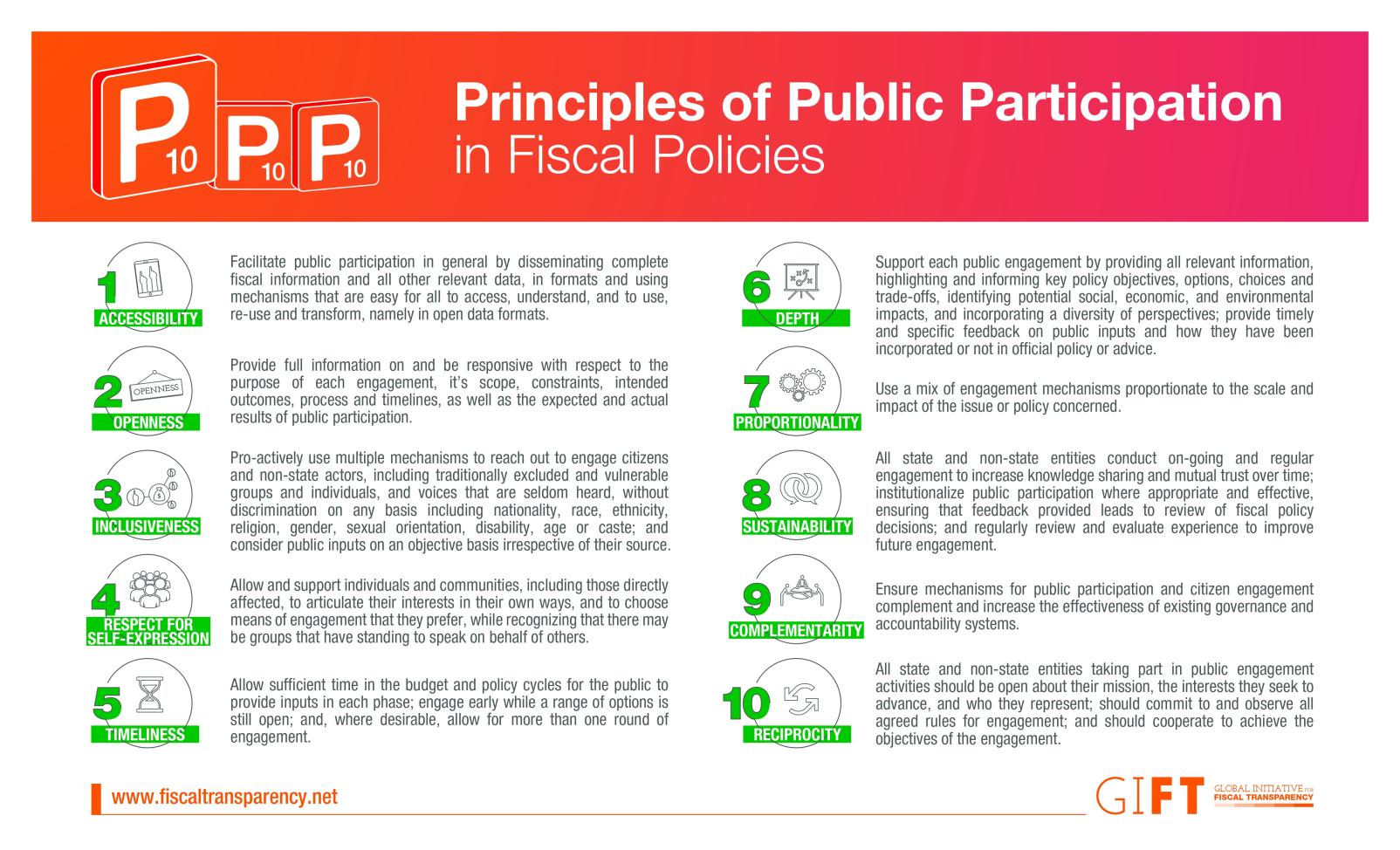
GIFT Principles of Public Participation in Fiscal Policy
The Global Initiative for Fiscal Transparency has ten principles for public participation in fiscal policy:
- Accessibility – facilitate public participation in general by disseminating complete fiscal information and all other relevant data, in formats and using mechanisms that are easy for all to access, understand, and to use, re-use and transform, namely in open data formats.
- Openness: provide full information on and be responsive with respect to the purpose of each engagement, it’s scope, constraints, intended outcomes, process and timelines, as well as the expected and actual results of public participation.
- Inclusiveness: pro-actively use multiple mechanisms to reach out to engage citizens and non-state actors, including traditionally excluded and vulnerable groups and individuals, and voices that are seldom heard, without discrimination on any basis including nationality, race, ethnicity, religion, gender, sexual orientation, disability, age or caste; and consider public inputs on an objective basis irrespective of their source.
- Respect for self-expression: allow and support individuals and communities, including those directly affected, to articulate their interests in their own ways, and to choose means of engagement that they prefer, while recognizing that there may be groups that have standing to speak on behalf of others.
- Timeliness: allow sufficient time in the budget and policy cycles for the public to provide inputs in each phase; engage early while a range of options is still open; and, where desirable, allow for more than one round of engagement.
- Depth: support each public engagement by providing all relevant information, highlighting and informing key policy objectives, options, choices and trade-offs, identifying potential social, economic, and environmental impacts, and incorporating a diversity of perspectives; provide timely and specific feedback on public inputs and how they have been incorporated or not in official policy or advice.
- Proportionality: use a mix of engagement mechanisms proportionate to the scale and impact of the issue or policy concerned.
- Sustainability: all state and non-state entities conduct on-going and regular engagement to increase knowledge sharing and mutual trust over time; institutionalize public participation where appropriate and effective, ensuring that feedback provided leads to review of fiscal policy decisions; and regularly review and evaluate experience to improve future engagement.
- Complementarity: ensure mechanisms for public participation and citizen engagement complement and increase the effectiveness of existing governance and accountability systems.
- Reciprocity: all state and non-state entities taking part in public engagement activities should be open about their mission, the interests they seek to advance, and who they represent; should commit to and observe all agreed rules for engagement; and should cooperate to achieve the objectives of the engagement.