

Imagine local communities from Blackpool’s vibrant coastal neighbourhoods to the green rolling hills of Derry City and Strabane and the urban waterways of Warrington, all asking the same question: What do we want for our place and how can action on climate help deliver that? This is the question at the heart of Thriving Places, a programme built on the simple belief that the path to net zero runs through people and place, not just policy.
Funded by Innovate UK, this work formed part of the Net Zero Living Programme, that supported local authorities, their partners and communities to overcome systemic barriers to the scaling and adoption of net zero solutions.
There’s nothing as lovely as being heard, you want to be part of a community where you are heard.
The imperative to decarbonise requires support and action from the public and can face resistance. To address public scepticism to net zero implementation you need to give citizens a significant voice in, and ownership of, net zero decisions from the outset, not as an afterthought once plans are already drawn up.


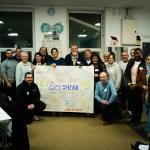
Together with Forum for the Future, Ipsos, and Quantum Strategy and Technology Ltd, we supported 28 local authorities across our nations, from Derry and Strabane to Blaenau Gwent and from the Outer Hebrides to Coleford in the Forest of Dean. We helped them to create a resident led direction for their place, connected to climate action, and built their understanding and confidence to engage the public long term.
We've shown placed based citizen engagement works for decarbonisation and gained key insights along the way - and we're pleased to share our learnings alongside resources for how it can be done elsewhere.
Starting where communities are
Rather than opening with carbon targets or technical strategy, we started with something far more familiar: the places people live, work and study in. Drawing on deliberative and participatory futures methods, we met people where they were.
We innovated a new approach called ‘Citizen Visioning’ — asking people what they valued about their area, alongside their hopes and concerns for the future. Over a series of structured sessions, participants develop a vision and recommendations for the future of their area that is rooted in local values.
We also held ‘Community Conversations’ across the UK - training local residents as ‘conversation starters’ to speak to family, friends and neighbours about their priorities for the future, in the context of climate change. This collective knowledge from communities shaped subsequent deliberations and ultimately their recommendations to the Council.
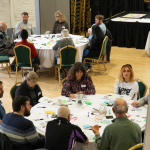
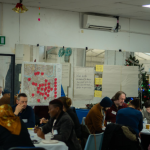
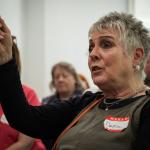
Within these two approaches we saw time and again, those conversations connected naturally towards net zero. People didn't need to be persuaded that climate action mattered, they needed the space to connect it to what was important to them about where they lived: warmer homes, cleaner air, thriving high streets, lower energy bills, new skills and better travel. From there, we worked with each group of local people and local actors to shape recommendations for net zero that responded to local needs and reflected what made their place unique.
By using familiar, accessible spaces – whether that meant running interactive school sessions with Wakefield’s young people or collaborating with trusted local partners through advisory groups in Blaenau Gwent – we made sure the vision for their place was built by everyone. Investing in focused outreach, Living Wage payments, robust onboarding, accessibility adjustments, and skilled facilitation, actively welcomed in marginalised and underserved communities that have often been less heard from.
It was nice to get that mix of people that wouldn’t necessarily have engaged with us before they took part [...], that’s always a challenge for us.
In leaning into local skills and knowledge, we also added social value through recruiting and onboarding local people to help deliver this work, prioritising under-represented groups in recruitment.
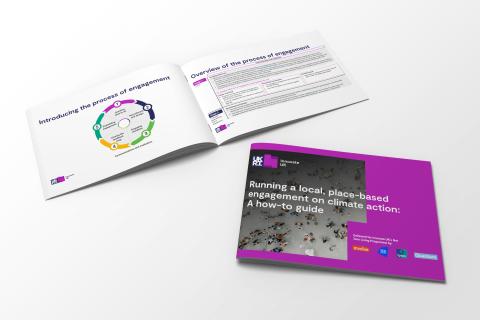
We designed a practical, step-by-step approach to running place-based citizen engagement on net zero and climate action.
The guide draws on real experience from 28 local authorities supported through the Programme. It introduces two tried-and-tested engagement methods: citizen visioning and community conversations.'
What impact did we achieve?
When people feel heard, they care
Time and time again Local Authority teams told us that the room felt different, the groups were more diverse and truly reflective of their whole community or target audience compared to usual engagement approaches.
Participants' knowledge of what their local authority was doing on net zero rose from 44% to 64%. Perhaps, more importantly, participants' emotions shifted from feeling "excited, curious and nervous" before engagement to "informed, empowered and hopeful" afterwards.
I think one thing that really added to participants’ experience and their trust in the process was how present the council were throughout [...]. People could see that and they could see how much you valued their time and the effort they were putting into the process.
At a time where public trust in institutions is low, we saw a positive trend emerge. When participants could see clear, visible pathways for their ideas to turn into action, their confidence grew or stayed high, it also fostered a willingness to be more involved in future local decisions.
I feel empowered by the process that our work will be taken seriously by the local council and that the suggestions and action plans could make a positive impact on our town.
Shaping real decisions and driving local economies
The results speak for themselves. Across the programme, 1,441 people were involved and 193 citizen recommendations were generated. 60-96% of those recommendations were adopted by the local authorities by the time of our final report. This is a sign that when people are genuinely listened to, their ideas don’t just sit on a shelf, they shape real decisions.
- Gatehead’s Local Authority has established the ‘Green Room’ a dedicated space for local residents to receive resources and advice on how to make changes to their own homes.
- Newham Council agreed to conduct retrofit assessments and begin retrofitting social housing blocks to improve energy efficiency and reduce energy bills, while also starting new conversations with local businesses about investing in North Woolwich in ways that reflect residents’ priorities.
- Coleford's recommendation of improving local employment opportunities has influenced the development of Gloucestershire County Council’s Green Skills Strategy and led to the creation of more entry-level and apprentice positions in the ecology and climate teams.
Across the recommendations, we found that citizens consistently linked climate action to local economic renewal. Participants emphasised setting and enforcing higher standards in new developments and existing homes, often coupled with calls to prioritise local suppliers and jobs.
It indicates that investing in citizen engagement does more than win hearts and minds; it improves decision-making and could lay the foundation for cost-effective policies that secure local financial wellbeing.
Accelerating climate action within interconnected systems
These approaches gave councils the confidence and support to develop and accelerate their net zero programmes knowing they carried real public support, whilst also delivering co-benefits that communities actually welcome. It was designed to feed into real decision making and connect to wider strategies and activities, for tangible, wide ranging impact.
Now we have this mandate from residents, we have the impetus to push (the climate change action plan) forward
Climate action is interconnected. A decision about transport affects air quality, which affects health, which affects local economic productivity. Place-based engagement can be the catalyst that allows different council departments (Housing, Transport, Public Health) to work in a cross cutting way, because people don’t live their lives in siloes.
At a time where Devolution is on the horizon for many Local Authorities, providing early opportunities for collaboration was a valuable part of the design process for some. In the Forest of Dean, where district and town councils will soon merge into one, we facilitated collaboration between both levels of council to design together a project to realise their ambition of community-led climate action plans for Coleford town.
Building for longer term impact
A further 15 local authorities’ received capacity building and strategy support on a range of aspects from policy to planning, marketplace principles to strategy development.
This work varied greatly. We helped Cardiff embed community trust into a city-scale home retrofit programme and partnered with Devon to strengthen small business climate resilience through targeted engagement strategies. In Norfolk, we broke down barriers to community energy through collaborative roundtables, while in the Outer Hebrides, we worked with close-knit community groups to support better dialogue, debate and disagreement needed to to implement climate adaptation approaches. In Northern Ireland, we supported the Northern Ireland Executive funded and newly formed Building Resilience in Communities (BRIC) team to build confidence and a shared language needed to embed genuine community engagement into emergency planning.
Local authority officers reported that the programme strengthened their understanding of in-depth, participatory engagement. Through training, insights, and hands-on learning, it also built the skills and relationships needed to ensure this work can continue and grow.
We’re required by government to do public engagement, but we aren’t able to [do] as much as we would like or as in-depth as we would like. This offered us something quite unique.
Sharing learning and resources
The capacity building and strategy work significantly extended the reach of the project, but we wanted to do more to get to the scale that is expressed in the Government’s Energising Britain plan. This work has demonstrated a clear route to citizen informed place- based change that needs to happen across the country, on climate action.
To support nationwide action, we have created a range of resources sharing our knowledge and learning to support wider uptake. These include:
- A video capturing the whole approach
- A practical guide, with a step-by-step approach to running place-based citizen engagement on net zero and climate action. This introduces two new, and now, tried-and-tested engagement methods: citizen visioning and community conversations.
- Our final report from this work, 'How Place-Based Citizen Engagement Can Shape a Positive, Decarbonised Future For The UK' shares a wealth of insights and practical knowledge from our work with 28 Local Authorities and their residents to make Net Zero deliver for their place.
- Our Cost of Not Engaging report provides evidence that the cost of not engaging is often much higher than the upfront investment. Through interviews we found that officer’s time spent defending unpopular decisions, legal challenges, and having to redesign programmes due to lack of public support, commonly far outweigh the upfront cost of doing engagement in a good and meaningful way.
Read the cost of not engaging report here
- Our Value of Participation report shows how public deliberation could act as an essential economic driver. Of the 193 citizen-led recommendations, 74% would directly increase overall capital (based on the five capitals model) and 70% would create job opportunities if implemented.
Read the value of participation report here
- Our Communities Driving Change report Draws learnings from local authority led projects and programme partners in the Net Zero Living Programme to identify innovative solutions for accelerating and delivering local net zero.
Read the communities driving change report here
- Six bite size videos to provide an 'introduction to public engagement on Net Zero'.
What does this mean for policy decisions going forward?
There is a clear lesson for national policy makers delivering net zero; place- based citizen engagement must be treated as core infrastructure, not a discretionary extra. Policy makers in Whitehall cannot know which specific street corner in a town feels unsafe for cyclists or which community hall is the best hub for a heat network. Grounding conversations in place is a far more effective starting point than abstract emissions targets and data. Local people can identify "hidden" barriers to adoption that high-level models miss. In this programme, participants consistently emphasised feasibility. They don't just want "green" solutions; they want solutions that work with the unique reality of their home.
The Energising Britain strategy presents a timely opportunity to amplify and build on these local recommendations, where we can remove duplication and foster genuine two-way collaboration between national and local government. Moving away from top-down 'behaviour change' towards shared decision-making unlocks an intrinsic community motivation, enabling the UK to deliver faster, deeper climate action.
What next?
We’re continuing to capture the learning from this work, with insights and resources shared here on our website for others to build on.
Our programme’s learning and training content was adopted by The Department for Energy and Net Zero (DESNZ). We have engaged all the regional hubs and have translated the learning into the ‘starting the conversation’ guidance.
This was an exciting, far-reaching programme. We are pleased to have worked alongside a wide range of local authorities and communities to achieve far reaching net zero solutions that are inclusive, just and work for communities.
Summary of resources and projects
Insight reports
- How place- based citizen engagement can shape a positive, decarbonised future for the UK (final report)
- Cost of not engaging
- Communities driving change
- Value of Participation
Resources
Project location

England
Birmingham
Blackpool
Calderdale
Devon
Dorset
Forest of Dean
Gateshead
Haringey
Lambeth
Liverpool
Newham
Norfolk
Northumberland
Nottingham (Broxtowe)
Portsmouth
South Oxfordshire
St Albans
Three Rivers
Wakefield
Warrington
Westminster City Council
Northern Ireland
Belfast
Derry & Strabane
Mid and East Antrim
Northern Ireland
Scotland
Fife
Outer Hebrides
Wales
Thank you
We are grateful to everyone who took part – residents, local authorities, local associates, partners and others – for their valuable contributions to this work.
If you'd like to find out more about this project, send us an email here.